A roof problem in a warehouse rarely stays a roof problem for long. It turns into damaged stock, interrupted operations, corrosion, safety complaints, and emergency spending. That is why the search for the best roofing company in KSA is not really about finding the lowest quote. It is about finding a contractor that can diagnose failure correctly, stop water ingress fast, and deliver a repair or rehabilitation system that holds up under heat, UV, dust, and aging metal.
For industrial and commercial facilities in Saudi Arabia, that standard is higher than it is for general building work. Warehouses, factories, logistics hubs, and production sites have large spans, roof penetrations, gutters, skylights, smoke vents, and sheet joints that fail in different ways. A contractor that only knows basic patching will not solve those conditions for long. The better choice is a roofing partner with engineering awareness, fabrication capability, waterproofing specialization, and crews that understand active industrial sites.
What defines the best roofing company in KSA?
The best roofing company in KSA should do more than install sheets or apply sealant. Industrial roofing work is a technical service. It starts with inspection, moves through root-cause diagnosis, and ends with a system that matches the roof type, the failure point, and the operating demands of the facility.
That matters because not every leak comes from the visible wet spot. Water can travel through laps, penetrations, ridge details, screw points, parapet junctions, drain areas, or gutter failure before it appears inside. On metal roofs, corrosion and thermal movement add another layer of complexity. On sandwich panel and single skin roofs, poor detailing at joints and accessories often causes recurring leaks that basic surface treatment will not fix.
A serious roofing company should be able to inspect those conditions, document them clearly, explain why they are happening, and recommend the right scope – whether that is localized waterproofing, partial rehabilitation, gutter treatment, fastener correction, flashing replacement, or full roof restoration.
Why industrial roofs in Saudi Arabia need specialized contractors
Industrial roofs in Saudi Arabia operate under harsh exposure. Heat cycling causes expansion and contraction. UV degrades lower-grade materials. Wind-driven dust and sand affect joints and surface condition. Moisture, when it enters the system, accelerates rusting around fixings, overlaps, and drainage points. Once corrosion starts, a roof can lose performance quickly.
This is why general maintenance teams often struggle with recurring leak complaints. They may close one opening while missing surrounding weak points. They may use materials that cannot handle movement or prolonged exposure. They may also treat the roof as a finish issue rather than a building-envelope issue.
The stronger contractors approach the roof as an operational asset. They look at waterproofing continuity, structural condition, drainage behavior, penetration detailing, and future maintenance access. For factories and warehouses, this is the difference between another repair cycle in six months and a solution that reduces disruption over the long term.
How to evaluate the best roofing company in KSA for your site
The first filter is technical range. If a contractor only offers one product or one repair method, that is a warning sign. Industrial roofs fail in multiple ways, so the contractor should be comfortable with metal roof rehabilitation, waterproofing systems, sheet replacement, gutter treatment, penetration sealing, flashing works, and repair planning across different roof types.
The second filter is inspection quality. A useful inspection is not a walkover followed by a generic quotation. It should identify leak points, rusted areas, failed joints, drainage concerns, and vulnerable accessories such as skylights, smoke vents, curbs, and duct penetrations. Better still if the contractor provides a structured report with photos and a breakdown of recommended action.
The third filter is execution capability. Many projects fail because diagnosis and site work are disconnected. Industrial clients need a contractor that can inspect, design the repair scope, fabricate where needed, install with trained teams, and stay accountable after handover. That single-source model reduces coordination gaps and usually leads to faster response when urgent failures appear.
The fourth filter is speed with control. Fast service matters, especially during active leaks, but speed without method creates repeat work. The right contractor mobilizes quickly while still managing safety, access planning, surface preparation, detailing, and quality checks.
What good roofing companies check before recommending a solution
A competent contractor does not start with materials. They start with failure points.
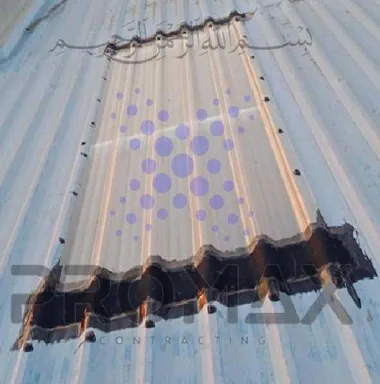
On metal roofs, they will check laps, screw penetrations, ridge caps, end laps, flashing conditions, rust progression, loose sheets, and movement-related cracks. On sandwich panel roofs, they will inspect panel joints, seal failure, edge detailing, and water pathways around curbs and openings. On corrugated and single skin sheet roofs, they will look at profile conditions, support stress points, and overlap vulnerability.
They will also inspect non-sheet elements that are often responsible for leaks. Gutters, drain points, skylights, smoke vents, roof penetrations, and duct interfaces are common weak areas. In many cases, those details are the actual source of water ingress, not the main field of the roof.
That is where specialized waterproofing systems become important. EPDM-based solutions, for example, are especially effective at difficult junctions, penetrations, drains, and aging metal roof details because they handle movement and create durable waterproofing at complex points. But even here, application quality matters. A strong material in the wrong detail is still a weak repair.
Red flags when comparing roofing contractors
A low price can be attractive, especially for large roof areas, but the cheaper option often strips out the work that actually protects the building. If surface cleaning is poor, rust treatment is skipped, detailing is rushed, or the wrong sealant is used, the apparent saving disappears fast.
Be careful with contractors who promise a total solution after a brief site visit without discussing the roof build-up, drainage, penetrations, or corrosion level. Also be cautious if the proposal is vague. Terms like repair as required or waterproofing application without area breakdown, detail scope, or material specification usually create disputes later.
Another red flag is weak after-sales support. Industrial roofs are not one-time consumer purchases. They need follow-up, maintenance awareness, and a contractor that responds when weather, movement, or aging creates new stress points. If a company is hard to reach before award, it will usually be harder to reach after completion.
The value of one contractor for inspection, repair, and support
For large industrial properties, the best arrangement is often one contractor managing the roof cycle from diagnosis through aftercare. That gives the client one point of accountability and one technical record of the roof condition.
It also helps when the work goes beyond simple leak repair. A roof issue may involve sheet damage, flashing fabrication, drainage correction, waterproofing at penetrations, and localized metal rehabilitation in the same project. Splitting that across several vendors slows decisions and increases the chance that one trade blames another.
This is where companies with broad industrial maintenance capability stand out. A contractor like ETCE KSA, for example, is built around that integrated model – site inspection, reporting, waterproofing design, fabrication support, installation, maintenance response, and after-sales backing under one service relationship. For facility teams, that means less coordination and faster movement from problem identification to durable repair.
What the best roofing company in KSA should deliver
At a minimum, the contractor should provide a clear diagnosis, a repair scope matched to the actual roof condition, trained execution teams, and practical support after completion. For industrial clients, that is the baseline.
The better contractors go further. They help building owners decide when a local repair is enough and when full rehabilitation is the smarter spend. They explain trade-offs between short-term patching and long-term waterproofing performance. They work around operating facilities with minimal disruption. And they understand that a roof is tied to safety, maintenance budgets, inventory protection, and business continuity.
That is the real standard when choosing a roofing partner in Saudi Arabia. You are not buying roof work in isolation. You are protecting the operating life of an industrial asset.
If you are comparing contractors now, ask the harder questions before you ask for the lowest number. The right roofing company will welcome that conversation, because durable roof performance starts with getting the problem right.
Related ETCE services
Need this checked on your own roof?
ETCE carries out industrial roof inspections, leak diagnosis, metal roof rehabilitation and EPDM waterproofing across Dammam, Al Khobar, Dhahran, Jubail, Riyadh and Jeddah.
Request a Roof Inspection WhatsApp Us