A roof usually does not fail all at once. It starts at the overlap that was never sealed correctly, the fastener that loosened under thermal movement, the gutter joint that held standing water, or the skylight curb that looked fine from ground level. For industrial buildings, choosing the best roof waterproofing methods is less about finding a miracle product and more about matching the system to the roof type, leak pattern, and operating conditions.
That distinction matters on warehouses, factories, and logistics buildings where a small leak can turn into insulation damage, corrosion, product risk, electrical exposure, and production disruption. The right waterproofing method should control water entry, tolerate movement, resist UV and heat, and remain serviceable over time. If it cannot handle those basics, it is a short-term patch, not a roof solution.
What makes a waterproofing method actually effective?
On industrial roofs, performance depends on three things – substrate condition, detail treatment, and long-term movement. A coating or membrane may perform well in one project and fail early in another because the roof beneath it was unstable, heavily corroded, or full of poorly treated penetrations.
This is why inspections matter before specifications. Metal roofs, sandwich panels, corrugated sheets, and mixed roof assemblies all behave differently. Some expand aggressively under heat. Some trap water at laps or gutters. Some already have multiple old repairs layered over each other. The best method is the one that addresses the real failure mechanism instead of simply covering stains.
Best roof waterproofing methods for industrial buildings
1. EPDM waterproofing for critical leak areas
For aging metal roofs and difficult details, EPDM is one of the strongest options available. It performs especially well at gutters, roof penetrations, curb details, skylights, drain points, and transition areas where movement and irregular geometry make conventional repair methods unreliable.
The value of EPDM is not just that it blocks water. It remains flexible, handles thermal movement well, and gives strong long-term performance under UV exposure when properly installed. On industrial roofs, that matters because many leaks do not come from open roof fields. They come from stress points where the roof moves daily and where sealants alone eventually split or detach.
This method is especially effective when the main roof sheets are still structurally serviceable but recurring leaks are concentrated at details. In those cases, targeted EPDM rehabilitation can extend roof life without full replacement. The trade-off is that installation quality is everything. Surface preparation, adhesion, edge termination, and compatibility with surrounding components must be handled by teams that understand roof behavior, not just membrane placement.
2. Elastomeric roof coatings for broad-surface protection
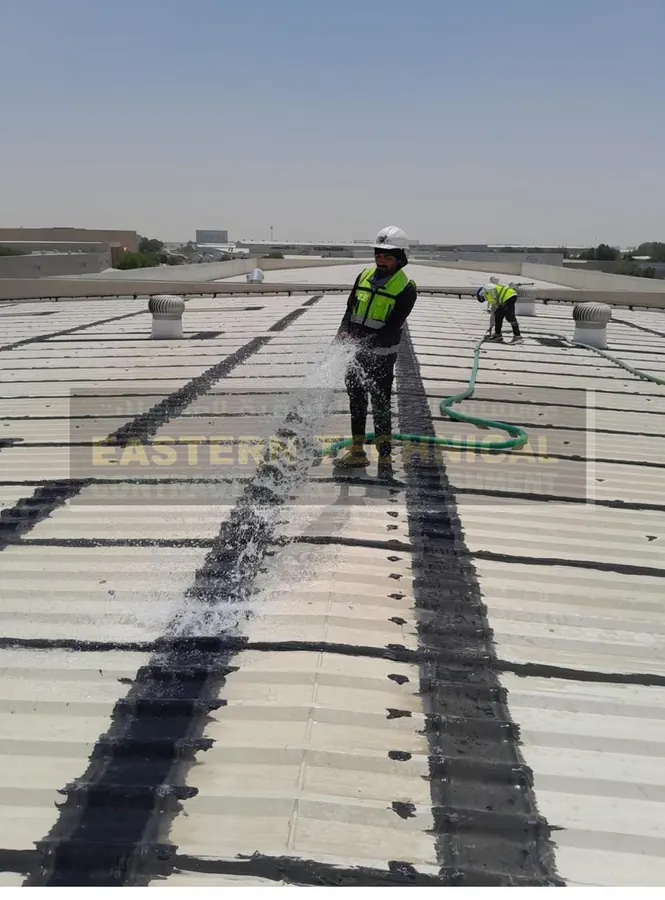
Elastomeric coatings are widely used when a roof needs a continuous waterproofing layer across large surface areas. On metal roofs, they can bridge minor hairline gaps, improve weather resistance, and reduce direct exposure of the substrate to sun and moisture.
They are useful where the roof has widespread aging but not severe structural deterioration. A coating system can help control leaks and slow further corrosion if cleaning, rust treatment, seam reinforcement, and surface preparation are done correctly first. That last point is where many projects go wrong. Coating over active rust, loose fasteners, or wet substrate only hides defects temporarily.
For owners balancing cost and service life, coatings are often attractive because they are less disruptive than major tear-off work. But they are not a cure for badly deformed sheets, failed flashing geometry, or advanced corrosion at supports and laps. When those conditions exist, the coating should be part of a repair strategy, not the whole strategy.
3. Seam and fastener waterproofing on metal roofs
Many industrial roof leaks start at mechanical joints rather than in the sheet itself. Standing seam details, overlap joints, exposed fasteners, and side laps are all vulnerable when movement, aging washers, vibration, or installation defects create pathways for water.
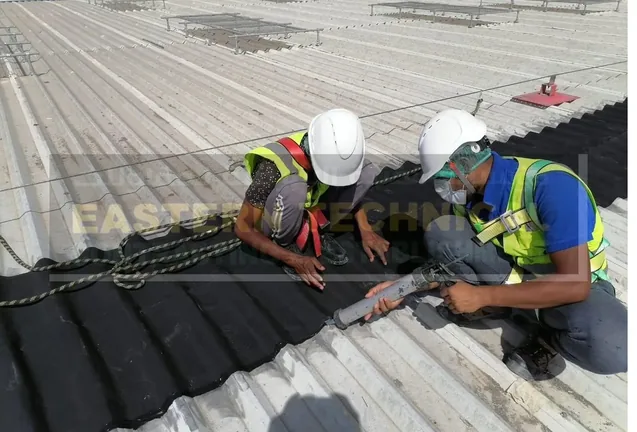
Targeted seam and fastener waterproofing is one of the most practical methods for metal roof rehabilitation. It involves tightening or replacing failed fasteners, sealing laps, reinforcing movement-prone seams, and treating corrosion before leaks spread deeper into the roof assembly. For warehouses and factories, this method is often the fastest route to leak control when the roof remains largely intact but has localized failure points.
Its limitation is scope. If the entire roof has reached the end of its service life, point-by-point repairs become repetitive and expensive. But for many facilities, this approach delivers strong value when used early, before widespread damage develops.
How to choose among the best roof waterproofing methods
Start with the roof type
A single-skin metal roof behaves differently from a sandwich panel roof. Corrugated sheets present different drainage and sealing challenges than flatter industrial profiles. If the waterproofing method does not account for panel geometry, movement, and attachment pattern, performance will be inconsistent.
On older metal roofs, corrosion mapping is just as important as leak mapping. Water may be entering in one area but traveling to another. A proper inspection should identify not only wet points but also weak details, rust progression, failed sealants, and areas where fabrication repairs may be needed.
Focus on details, not just the field area
Facility teams often look first at the largest visible roof surface. In practice, many failures happen at gutters, valley sections, smoke vents, curbs, HVAC penetrations, and junctions between old and new work. These details should drive the waterproofing design.
A field coating with poor penetration treatment will still leak. A membrane patch without proper edge termination will still lift. A sealant-only repair on a high-movement joint will usually fail sooner than expected. The best results come when details are engineered first, then integrated into the wider roof treatment.
Decide whether the goal is repair, rehabilitation, or life extension
Not every project needs complete replacement. In many industrial facilities, the practical objective is to stop leakage, control rust, and extend roof service life while keeping operations active. That is where selective waterproofing methods can outperform more disruptive options.
But there is a limit. If structural metal loss is advanced, if panel alignment is failing, or if water damage has become systemic, rehabilitation must be assessed more critically. Spending on repeated short-term fixes can cost more than a properly engineered intervention.
Common mistakes that lead to repeat leaks
One of the biggest mistakes is treating all roof leaks as sealant problems. Sealants have a role, but they are not a substitute for mechanical correction, substrate preparation, or proper membrane detailing. Another mistake is applying waterproofing over dirt, oxidation, loose coatings, or wet surfaces. Adhesion failures often begin there.
There is also the issue of partial diagnosis. A leak at a ceiling point does not always mean the roof failed directly above it. Water migrates along purlins, panels, and insulation paths. Without a systematic inspection, repair crews can fix the wrong location and leave the real entry point active.
On industrial sites, access and execution planning matter too. Work around active operations, roof traffic, and safety controls must be factored into the method selection. A technically good system can still become a poor project choice if it causes unnecessary downtime or cannot be installed reliably under site conditions.
Where engineered waterproofing adds the most value
The highest-value projects are usually not the simplest roofs. They are the facilities with recurring leaks at multiple details, aging sheet systems, corroded gutters, or years of inconsistent patching. In those cases, waterproofing should be treated as an engineered maintenance solution, not a commodity purchase.
That means inspection, failure analysis, repair scope definition, fabrication where needed, installation sequencing, and post-work support should all connect. This is where a specialist contractor has a clear advantage over a basic applicator. For industrial assets in Saudi Arabia, especially in high-heat and high-UV conditions, that integrated approach tends to produce far better durability than piecemeal repairs.
ETCE KSA works in exactly this space – industrial roof maintenance, metal roof rehabilitation, and EPDM-based waterproofing solutions for leak-prone roof details and aging warehouse structures.
The method is only as good as the diagnosis
The best roof waterproofing methods are not universal. EPDM is excellent for difficult details and movement-prone leak points. Coatings can be effective for broad-surface rehabilitation when the substrate is still sound. Seam and fastener treatment is highly practical on serviceable metal roofs with localized failures. Each can perform well. Each can also underperform if applied to the wrong condition.
If your roof is leaking repeatedly, the smart move is not to ask which product is cheapest. It is to ask what is actually failing, how water is moving, and which system will still be performing after the next heat cycle, storm event, and maintenance season. That is where durable waterproofing starts.
Related ETCE services
Need this checked on your own roof?
ETCE carries out industrial roof inspections, leak diagnosis, metal roof rehabilitation and EPDM waterproofing across Dammam, Al Khobar, Dhahran, Jubail, Riyadh and Jeddah.
Request a Roof Inspection WhatsApp UsMetal roof waterproofing across Saudi Arabia
ETCE is a metal roof waterproofing company in Saudi Arabia with its head office in Dammam. See our warehouse & factory roof waterproofing service or find your area: