A roof leak in an active warehouse rarely starts as a small problem. It shows up as rust at fasteners, staining near skylights, wet insulation, dripping at drain points, or repeated patchwork that fails after the next rain. When industrial assets are involved, choosing the right waterproofing experts in Dammam is less about getting a quick fix and more about preventing shutdowns, corrosion, product damage, and repeat maintenance.
For facility managers and project teams, that decision gets more technical on metal roofs, sandwich panels, aging sheets, and complex roof layouts with penetrations, ducts, gutters, and smoke vents. Many leaks are not coming from the open roof area at all. They start at movement joints, screw points, lap joints, curb flashings, cracked sealants, loose drainage details, or areas where previous repairs were applied without solving the actual failure path.
What waterproofing experts in Dammam should actually diagnose
A competent contractor should not begin with product sales. They should begin with failure mapping. On industrial and commercial roofs, water entry often travels away from the visible drip point, which means surface observation alone is not enough. The roof has to be inspected as a system.
That includes checking sheet condition, coating breakdown, corrosion levels, fastener integrity, overlap joints, ridge and side laps, gutter lines, flashing terminations, skylight upstands, pipe penetrations, and drain details. On older metal roofs, thermal movement matters just as much as visible damage. If the building expands and contracts daily under high heat, any repair method that cannot handle movement is likely to crack, pull apart, or lose adhesion over time.
This is one reason industrial clients tend to prefer a contractor that can inspect, report, design, fabricate details, and execute the repair with one team. Splitting diagnosis from installation often leads to gaps in accountability. If the leak returns, everyone points somewhere else.
Why industrial roofs fail differently
A warehouse roof is not the same as a residential slab, and the repair logic should not be the same either. Industrial buildings face aggressive exposure from UV, heat, dust, standing water in low-slope areas, and mechanical stress around mounted services. Add corrosion, older roof sheets, and poor historic repairs, and the leak pattern becomes more complex.
Metal roofs in particular need waterproofing systems that respect movement. A rigid patch over an active joint may look acceptable on day one and fail in a short cycle. The same applies to gutters and drainage points. If the repair blocks movement, traps water, or leaves edges unsealed, the weak point simply shifts to the next joint.
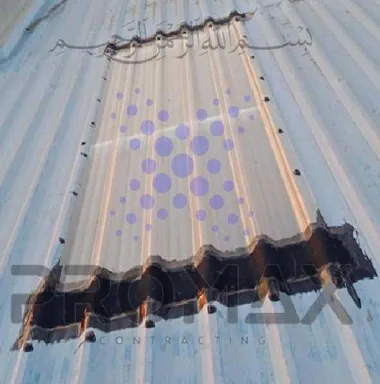
Sandwich panel roofs create another set of issues. Once water enters through joints or damaged edges, it can affect insulation performance and spread undetected. Single-skin sheet roofs and corrugated sheets often develop chronic leakage around fixings and laps, especially where aging, rust, and repeated sealant applications have already compromised the surface.
What to look for in waterproofing experts in Dammam
The first sign of a serious contractor is that they ask detailed questions before pricing. They should want to know the roof type, age, leak history, access conditions, production sensitivity, and whether the problem is isolated or widespread. If they offer a generic fix without site data, that is usually a warning sign.
The second sign is technical range. Industrial waterproofing rarely stays in one lane. A project may need roof leak tracing, sheet replacement, flashing correction, gutter rehabilitation, EPDM detailing, sealant replacement, fastener treatment, and corrosion control in one scope. If a contractor only handles one narrow activity, you may still end up coordinating multiple vendors to finish one roof.
The third sign is reporting quality. A useful inspection should identify active leak points, vulnerable details, probable water paths, condition ratings, and a repair approach that matches the roof’s actual service life. A vague recommendation to apply coating everywhere is not engineering. Sometimes a coating helps. Sometimes localized EPDM detailing is the right answer. Sometimes the roof needs section replacement before waterproofing begins. It depends on substrate condition, movement, and corrosion level.
Where long-term waterproofing performance usually comes from
On industrial roofs, long-term performance usually depends on detail treatment more than broad coverage. Most failures happen at transitions and interruptions, not in the middle of a clean roof sheet. That is why specialized systems such as EPDM can be especially effective when used at difficult leak points like penetrations, skylights, curb edges, drain points, and gutters.
EPDM is not a cure-all, and it should not be presented that way. Its strength is flexibility, weather resistance, and reliable performance at areas exposed to movement and difficult geometry. On aging metal structures, that matters. If the substrate is prepared properly and the detail is designed correctly, EPDM-based waterproofing can outperform repeated liquid patching that becomes brittle or detaches.
Still, product choice alone does not solve execution mistakes. Surface preparation, edge termination, joint detailing, drainage correction, and compatibility with the existing roof system all affect the result. The best waterproofing experts know that durability starts with method, not just material.
The trade-off between patch repair and roof rehabilitation
Not every leaking roof needs full rehabilitation. Not every leaking roof should be patched either. The right path depends on how widespread the failure is.
If leakage is limited to a few penetrations, drains, or localized laps, targeted repair may be practical and cost-efficient. If corrosion is advanced, fixings are failing across the roof, and past repairs are scattered everywhere, localized patching may only delay a larger problem. In those cases, a rehabilitation strategy often gives better cost control over time because it reduces repeated access, repeat callouts, and ongoing interior damage.
This is where experienced contractors add value. They should be able to tell you when a short-term repair is reasonable and when it is just deferring risk. Honest scope advice matters, especially for owners balancing capital budgets with operational pressure.
Why response time matters as much as system choice
For active factories, logistics facilities, and storage buildings, leak response is operational. A delayed site visit can mean damaged stock, interrupted workflows, electrical risk, and accelerated corrosion. Fast mobilization is not a marketing extra. It is part of the technical service.
A capable waterproofing contractor should be able to inspect quickly, document clearly, and move from diagnosis to execution without weeks of coordination. That matters even more when fabrication support is required for flashings, trims, covers, or replacement metal details. One contractor managing inspection, detailing, installation, and after-sales support usually shortens the recovery cycle.
That contractor model is especially useful in Dammam, where industrial facilities often cannot afford extended access disruption or uncertain maintenance sequencing. ETCE KSA works in this service-driven model, which is why clients managing warehouses and factories often prefer a single engineering and maintenance partner instead of fragmented repair packages.
Questions decision-makers should ask before awarding the work
Ask how the contractor identifies the true leak source rather than the visible symptom. Ask what roof types they handle and whether they have experience with metal roofs, sandwich panels, single-skin sheets, corrugated roofs, and difficult details like skylights, smoke vents, gutters, and duct penetrations.
Ask what preparation is required before waterproofing starts. Ask how movement is handled, how drainage issues are addressed, and what happens if corrosion is found under existing failed repairs. Ask whether they can fabricate and install supporting metal details when needed. Most importantly, ask what support looks like after the job is complete.
These questions quickly separate commodity applicators from real industrial waterproofing specialists.
Choosing for fewer callbacks, not just a lower quote
A lower quote can be expensive if it ignores hidden failure points, uses the wrong detail system, or skips preparation steps that are not visible once the work is done. Industrial roof waterproofing should be judged on leak prevention, service life, execution control, and how well the repair aligns with the building’s operating reality.
The right contractor will speak clearly about limits, risks, and repair priorities. They will not pretend every roof needs the same system. They will inspect first, recommend based on condition, and execute with attention to movement, drainage, corrosion, and detail integrity.
If you are evaluating waterproofing experts in Dammam, choose the team that treats your roof like a working industrial asset, not a surface to be covered. That is usually where the real savings begin.
Related ETCE services
Need this checked on your own roof?
ETCE carries out industrial roof inspections, leak diagnosis, metal roof rehabilitation and EPDM waterproofing across Dammam, Al Khobar, Dhahran, Jubail, Riyadh and Jeddah.
Request a Roof Inspection WhatsApp Us