A factory gutter usually starts leaking long before water shows up inside the building. By the time stains appear on purlins, wall cladding, stock areas, or electrical routes, the gutter has often been holding standing water, failed laps, corrosion, and movement for months. That is why knowing how to waterproof factory roof gutters is less about applying a coating and more about correcting the full leak path from roof sheet to outlet.
Industrial gutters fail differently than residential systems. They carry higher water volumes, sit between long metal roof runs, absorb thermal movement, and often serve aging buildings where previous patchwork has already complicated the detail. On a warehouse or factory, the right repair has to survive heat, UV, ponding, debris, and structural movement without forcing repeated shutdowns for maintenance.
How to waterproof factory roof gutters the right way
The first step is diagnosis, not product selection. If a contractor starts with a generic waterproofing material before checking slope, joint condition, outlet capacity, rust depth, and sheet interfaces, the repair may look complete but still fail in the next storm. Factory gutters leak for a reason, and the waterproofing system only performs when that reason is addressed first.
Most industrial gutter failures come from a combination of issues rather than one visible crack. You may have corroded steel at the base, loose fasteners at the edge detail, failed sealant at overlap joints, clogged outlets creating ponding, and movement at roof-to-gutter transitions. Treating only the wettest point rarely solves the problem.
Start with a full condition assessment
A proper assessment should identify whether the gutter is still structurally sound enough to be lined, or whether sections need replacement before waterproofing begins. This matters because no membrane performs well over weak, perforated metal that continues to deform under water load.
On industrial sites, inspection should cover base metal thickness loss, active rust, previous repair materials, standing water depth, unsupported spans, joint separation, penetration details, outlet condition, downpipe connection, and the tie-in with roof sheets or parapet edges. In older factories, it is also common to find incompatible patch repairs layered on top of one another. Bitumen, silicone, acrylic, cementitious patching, and tape repairs can all interfere with adhesion if they are not removed or isolated correctly.
Common reasons factory roof gutters keep leaking
A gutter may appear to leak from the center channel, but the actual entry point can be elsewhere. Water tracks. It follows laps, fastener holes, rust paths, unsealed upstands, and poorly terminated flashings before showing itself inside.
The most common cause is prolonged ponding. When outlets are undersized, blocked, or badly positioned, water stays in the gutter longer than intended. That accelerates corrosion and exposes every seam to continuous wetting. Thermal movement is another major factor. Metal factory roofs expand and contract daily, and the gutter detail has to move with them. Rigid repairs tend to crack or separate at the edges.
Corrosion is equally critical. Once rust starts eating into laps, corners, and outlet zones, a surface-only repair becomes temporary. The substrate has to be stabilized first. In some cases, the right solution is partial metal rehabilitation followed by a fully bonded lining system rather than repeated spot sealing.
Why patch repairs usually fail
Short-term patching has its place for emergency control, but it should not be confused with a durable waterproofing strategy. Smearing sealant over wet rust, bridging a split with generic tape, or applying coating over contaminated metal may stop leakage briefly. It rarely survives an industrial roof cycle.
The reason is simple. Factory gutters move, hold dirt, face intense UV, and often remain wet around outlets. If the preparation is weak, the bond fails. If the detail is wrong, the membrane lifts at terminations. If the drainage problem remains, the repair sits under water and degrades faster.
The most reliable method for industrial gutters
For many factory and warehouse applications, EPDM-based waterproofing is one of the most reliable options because it handles movement well and performs strongly in exposed roof conditions. That does not mean every gutter should receive the same detail. The thickness, fixing method, edge treatment, and substrate preparation depend on gutter geometry, corrosion level, and whether the system is being installed over rehabilitated metal or existing sound substrate.
EPDM works well in industrial gutter environments because it can create a continuous waterproof layer across joints, corners, outlets, and transition points that are hard to treat with liquid-only systems. It also tolerates thermal cycling better than many brittle repair methods. On long factory roofs, that flexibility matters.
Surface preparation decides the result
If there is one stage that determines service life, it is preparation. The gutter must be cleaned back to a stable surface. That includes removing dust, loose rust, failed mastics, previous patch materials, biological buildup, and any contamination that affects adhesion. Corroded sections may need mechanical treatment, priming, reinforcement, or localized metal replacement before the membrane goes in.
Outlets and drain points deserve special attention. This is where many leaks restart after an otherwise acceptable repair. The membrane has to be integrated properly into the outlet detail so water is directed out without exposing cut edges, loose laps, or unsupported corners.
A practical sequence for waterproofing factory gutters
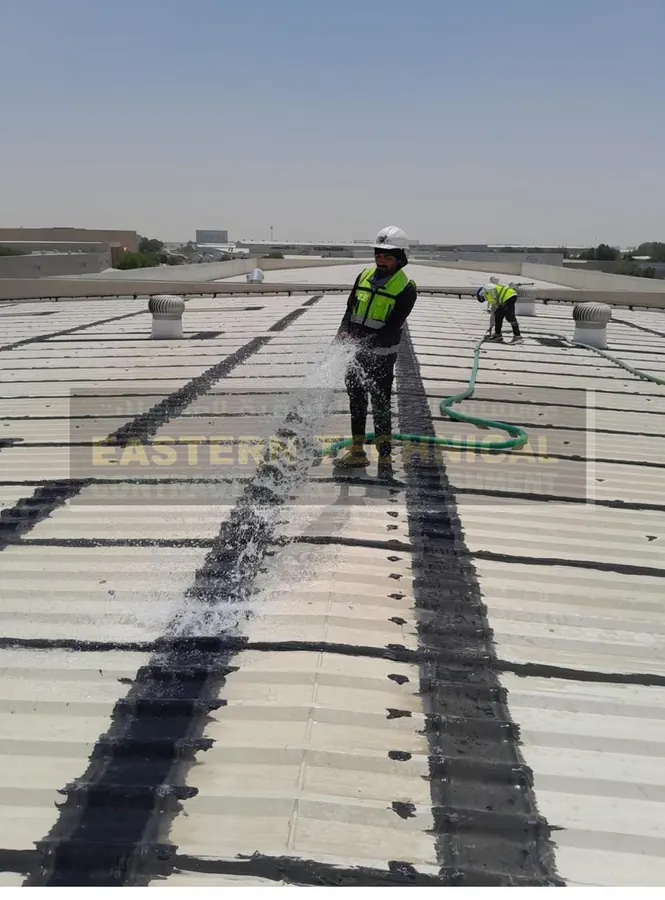
The process usually begins with safe access planning and a close inspection of all gutter runs. Once the defective areas are mapped, debris is removed and water flow is tested. Any structural issues, severe perforation, or detached sections are repaired first, because waterproofing should not be used to hide failed metalwork.
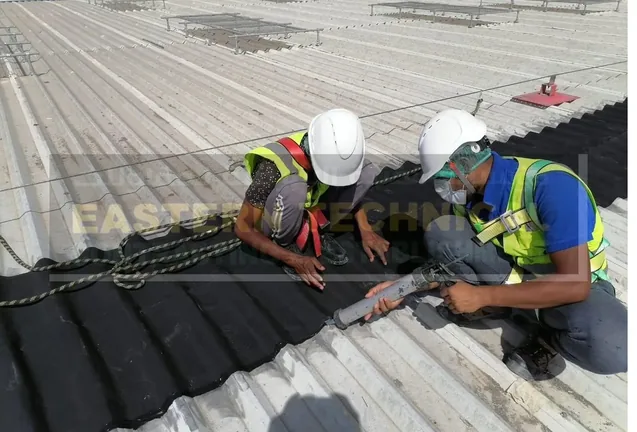
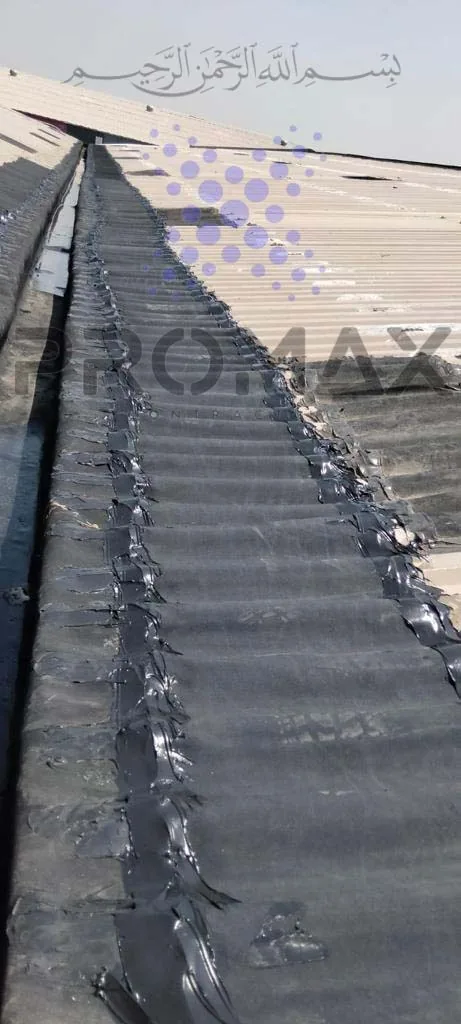
After that, the substrate is prepared and leveled where needed. Sharp edges, open seams, and unstable patching are corrected. Primer or bonding preparation is then applied according to the membrane system being used. The waterproof lining is installed continuously along the gutter base and dressed carefully into corners, joints, stop ends, expansion areas, and outlets. Terminations are secured so movement or water pressure does not peel the system back over time.
The final stage is quality control. That includes checking seam integrity, outlet flow, adhesion at all detail points, and whether any low areas still trap water excessively. Some ponding can be tolerated in certain industrial gutters if the membrane is designed for it, but uncontrolled standing water should never be ignored just because the gutter is now lined.
When replacement is better than lining
Not every gutter should be waterproofed in place. If corrosion has deeply weakened the channel, if support is failing, or if the original design is too narrow for current runoff conditions, lining alone may only postpone a bigger problem. In those cases, partial or full gutter replacement with proper waterproof integration is the better investment.
This is where engineering judgment matters. A cheaper repair can become the more expensive choice if it leads to repeat access costs, stock damage, production disruption, or corrosion spreading into adjacent roof components.
What facility teams should ask before approving the work
The right question is not just what material will be applied. Ask how the contractor will handle rusted sections, movement joints, roof-to-gutter interfaces, outlet detailing, and termination security. Ask whether the system is designed for ponding conditions. Ask what preparation method will be used and whether the contractor is equipped to fabricate or replace defective metal sections when required.
For active facilities, execution planning also matters. Waterproofing work should be staged to reduce operational disruption and avoid leaving open areas exposed. On large industrial sites in Saudi Arabia, where heat, UV exposure, and dust put extra pressure on roof systems, practical site control is as important as the membrane itself.
ETCE KSA typically sees the same pattern on aging factories and warehouses: the visible leak is only one part of the failure, while the real issue is a combination of corrosion, drainage weakness, and poor historic patching. The best results come from treating the gutter as a system, not as a crack to be covered.
A factory roof gutter does not need cosmetic repair. It needs a waterproofing solution that respects metal movement, restores drainage performance, and holds up under industrial service conditions. If the diagnosis is accurate and the detail work is done properly, the repair lasts longer, the maintenance cycle slows down, and the roof stops demanding attention every time heavy rain hits.
Related ETCE services
Need this checked on your own roof?
ETCE carries out industrial roof inspections, leak diagnosis, metal roof rehabilitation and EPDM waterproofing across Dammam, Al Khobar, Dhahran, Jubail, Riyadh and Jeddah.
Request a Roof Inspection WhatsApp UsMetal roof waterproofing across Saudi Arabia
ETCE is a metal roof waterproofing company in Saudi Arabia with its head office in Dammam. See our warehouse & factory roof waterproofing service or find your area: