A stain on a warehouse ceiling is rarely the location of the leak. Water can enter at a roof penetration, travel along a purlin or insulation layer, and appear several meters away from the actual failure point. This guide to roof leak diagnosis is designed for facility teams managing metal roofs, sandwich panels, corrugated sheets, gutters, skylights, and aging industrial structures where a quick patch can hide a larger problem.
For factories, logistics facilities, and storage buildings, diagnosis must establish more than where water is visible. It must identify the entry point, the failed component, the extent of concealed deterioration, and the repair system that will continue to perform under heat, UV exposure, wind, sand, and thermal movement.
Start With Safety and Operational Control
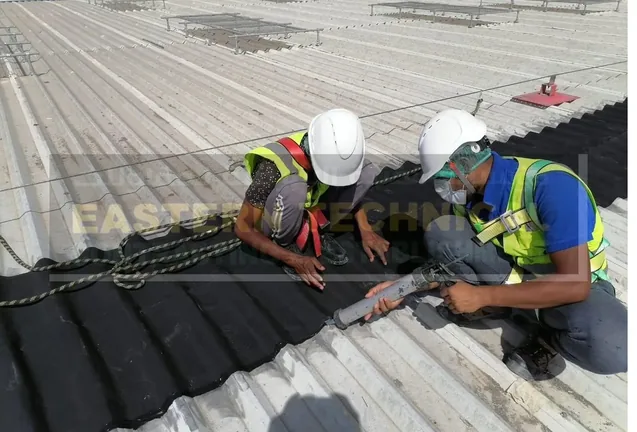
Roof inspection begins with site control. Wet metal sheets, brittle skylight panels, corroded walkways, and unsecured roof openings create serious fall hazards. Do not send maintenance personnel onto a roof without appropriate access equipment, fall protection, and a clear route that avoids unsupported areas.
Inside the building, protect stock, machinery, electrical equipment, and active work zones before investigation starts. Record the time of the leak, weather conditions, wind direction, and the exact area where water appeared. A leak that occurs only during wind-driven rain may point to laps, flashings, ridge details, or sidewall interfaces rather than a simple hole in the roof sheet.
It also helps to distinguish active water entry from condensation. Condensation commonly appears across wider roof areas, especially where ventilation, insulation, or vapor control is inadequate. A roof leak is more likely to create a concentrated drip path, staining around a penetration, or wet insulation localized near a seam or gutter.
Map the Leak Before Inspecting the Roof
The most efficient diagnosis starts from inside the building. Mark the visible drip point on a floor plan, then note nearby columns, roof trusses, sprinkler lines, ducts, cable trays, and roof penetrations. These fixed references are more reliable than estimating distance from a wall in a large warehouse.
Trace signs of water migration upward and outward. Look for rust marks on purlins, damp insulation, discolored panel joints, mold growth, swollen lining materials, and corrosion around fasteners. Water follows gravity, but it can also move horizontally along structural members, sheet laps, and concealed channels.
A ceiling stain directly below a roof-mounted exhaust fan does not prove that the fan curb is leaking. The source may be an upslope fastener line, an open panel lap, or a failed flashing above it. This is why a roof leak diagnosis should treat the interior evidence as a starting point, not a final answer.
Inspect the High-Risk Failure Points
Industrial metal roofs do not usually fail evenly. Most leaks develop at transitions, movement points, and locations where different materials meet. A systematic inspection should prioritize the following areas:
- Roof penetrations, including pipes, ducts, cable routes, vents, smoke vents, and equipment supports
- Skylight curbs and translucent roof sheet connections
- Gutters, valley gutters, drain outlets, overflow points, and end laps
- Ridge caps, hip details, sidewall flashings, and roof-to-wall junctions
- Sheet overlaps, panel joints, fastener lines, and loose or missing closure strips
- Areas of corrosion, ponding water, impact damage, previous patching, and roof modifications
At each point, inspect the full detail rather than only the visible crack. For example, a split sealant bead around a pipe may be the symptom of movement in the pipe support, loose flashing, or an incorrectly formed penetration detail. Adding more sealant without correcting the movement will usually produce another failure.
Fasteners, Washers, and Sheet Laps
Fastener-related leaks are common on single-skin and corrugated metal roofs. Over time, screws can back out due to thermal cycling and vibration. Their neoprene washers may harden, crack, flatten, or separate from the sheet profile. Overtightened fasteners can distort the metal and damage the washer, while underdriven fasteners leave a path for water entry.
Sheet laps should be checked for failed butyl tape, deteriorated sealant, inadequate overlap, and capillary action. Wind-driven rain can force water uphill into a poorly sealed lap. The repair may require lifting and resealing the joint, replacing damaged fixings, and installing a compatible waterproofing treatment across the vulnerable connection.
Penetrations and Flashing Interfaces
Penetrations are among the most demanding leak points because the roof and the penetrating item often move at different rates. Metal roof sheets expand and contract under Saudi Arabia's high temperatures. A rigid repair around a duct, pipe, or curb can split when that movement repeats season after season.
Inspect for cracked sealant, detached flashing edges, poorly formed corners, exposed screw heads, and water trapped behind upslope flashings. Also check whether added equipment has been installed without a properly engineered curb or penetration boot. A field-cut opening with improvised sealant may hold briefly, then fail when heat and movement stress the joint.
EPDM-based waterproofing systems can be particularly effective at these complex interfaces when they are properly detailed, prepared, and terminated. The material must work with the roof profile and drainage path, not create a raised edge that traps water or directs it beneath adjacent sheets.
Gutters, Drains, and Water Flow
A roof can be watertight at the sheet level and still leak because drainage has failed. Debris, sand accumulation, corrosion, disconnected outlets, undersized drains, and standing water place constant stress on gutter seams and joints. Water that backs up behind a gutter can enter through sidewall flashings or lower sheet laps.
Check for ponding after rainfall or controlled water testing. Look for rust at gutter bottoms, seam separation, failed outlet connections, and distorted slopes. If corrosion has thinned the metal, surface coating alone may not be enough. The affected section may need rehabilitation, lining, or replacement depending on the extent of material loss.
Use Water Testing Carefully
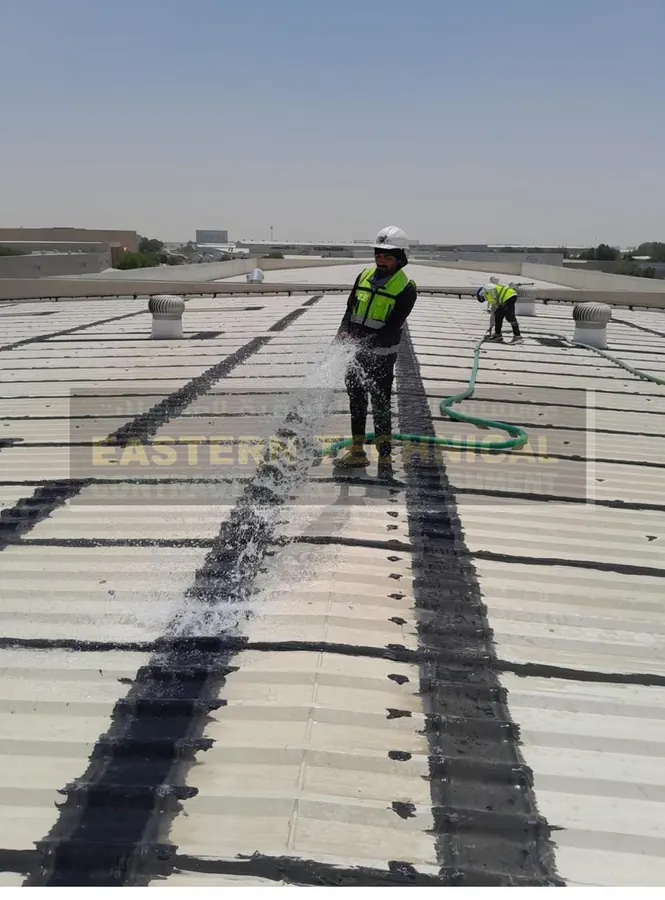
When visual inspection does not confirm the source, controlled water testing can isolate the entry point. This method should be performed in sections, beginning at the lowest suspected area and moving upslope. Apply water gradually while an observer remains inside the building to identify the first sign of entry.
Do not flood the entire roof at once. That approach makes the result unreliable and can overload drainage systems. Avoid testing during high wind, and allow time between sections because water may travel through insulation or structural channels before becoming visible.
Water testing is useful for flashings, skylight perimeters, penetration details, and localized sheet laps. It is less conclusive where moisture has accumulated inside a roof assembly or where multiple defects exist. In those cases, inspection findings, moisture evidence, roof age, and repair history must be assessed together.
Determine Whether the Problem Is Local or Systemic
The repair decision depends on failure pattern, not just leak size. A single puncture from maintenance traffic may justify a local repair. Repeated leaks across multiple laps, widespread washer failure, extensive rusting, or cracking around numerous penetrations indicate a system-level issue.
Review previous repair locations. If the same roof receives frequent sealant patches, the building may be reaching the point where targeted patching costs more in disruption and repeat visits than a planned rehabilitation program. This is especially relevant for older metal roofs where corrosion is advancing beneath prior coatings or where thermal movement has compromised many joints.
A proper report should identify the roof type, observed defects, probable water paths, affected areas, recommended repair scope, and urgency level. It should also separate immediate containment work from durable corrective work. A temporary patch may protect operations during active rainfall, but it should not be presented as a long-term system repair.
Select a Repair That Matches the Roof Detail
Not every leak needs the same solution. Fastener replacement and lap resealing can resolve isolated defects on otherwise sound metal sheets. Damaged flashing around a curb may require a rebuilt transition detail. Corroded gutters may need a waterproof lining system or replacement sections. Broad deterioration may justify metal roof rehabilitation using a compatible waterproofing system across vulnerable areas.
Material compatibility matters. Some coatings, sealants, and membranes do not bond reliably to oxidized metal, contaminated surfaces, or existing repair materials without correct preparation. The roof must be cleaned, dried, treated for corrosion where required, and primed or mechanically secured according to the selected system.
The strongest repair is not necessarily the thickest material. It is the detail that accommodates movement, maintains drainage, seals the transition, and can be inspected and maintained over time. For active industrial sites, execution planning also matters: access routes, work sequencing, weather windows, protection of operations, and safe handling around equipment all affect the quality of the result.
Turn Diagnosis Into Preventive Maintenance
After repair, establish a practical roof inspection schedule. Check critical areas before the rainy season, after severe weather, and following any new rooftop equipment installation. Keep gutters clear, monitor corrosion, replace deteriorated fasteners before they become leak points, and document every repair location.
For warehouse and factory owners in Dammam, Riyadh, and across KSA, roof performance is directly tied to asset protection and operational continuity. A disciplined inspection identifies small defects before they become damaged insulation, corroded structure, equipment exposure, and production disruption. The next water mark should be treated as evidence to investigate, not simply a spot to cover.
Related ETCE services
Need this checked on your own roof?
ETCE carries out industrial roof inspections, leak diagnosis, metal roof rehabilitation and EPDM waterproofing across Dammam, Al Khobar, Dhahran, Jubail, Riyadh and Jeddah.
Request a Roof Inspection WhatsApp UsMetal roof waterproofing across Saudi Arabia
ETCE is a metal roof waterproofing company in Saudi Arabia with its head office in Dammam. See our warehouse & factory roof waterproofing service or find your area: