A warehouse roof can look serviceable from ground level while water is already entering through a failed fastener, cracked sealant joint, loose flashing, or corroded sheet overlap. For facility operators, industrial roof maintenance KSA is not a cosmetic task. It is a planned protection measure that prevents stock damage, production interruptions, electrical risk, and progressive deterioration of the building structure.
Saudi industrial roofs work under severe conditions. High surface temperatures, strong UV exposure, wind-driven sand, occasional heavy rain, humidity in coastal areas, and thermal movement all place stress on metal sheets, joints, gutters, and penetrations. A repair that only covers the visible leak may stop water temporarily, but it will not address the movement, corrosion, or drainage issue that caused the failure.
Why Industrial Roofs Fail Before Their Expected Life
Most industrial roof failures are not caused by one dramatic event. They develop at predictable weak points that receive little attention until a leak reaches the occupied space below. On corrugated sheets, single-skin roofs, sandwich panels, and older metal structures, the most vulnerable locations are usually laps, screw penetrations, ridge details, gutters, skylights, smoke vents, drain points, and connections to walls or ducting.
Thermal expansion is a major factor. Metal roofing expands in extreme heat and contracts when temperatures fall. That movement gradually loosens fasteners, stretches sealant, and opens joints. If the roof has been repaired repeatedly with incompatible materials, the problem can become worse. A hard patch applied over a moving joint may crack, while water continues traveling beneath the surface.
Corrosion also changes the scope of repair. Surface rust may be treatable through preparation and protective coating, but perforated sheets, weakened purlin connections, and extensively rusted gutter sections require a more detailed engineering assessment. The right decision depends on the remaining condition of the substrate, not simply the size of the stain or hole.
What Planned Industrial Roof Maintenance in KSA Should Cover
A planned maintenance program starts with a site inspection that identifies how and where water is entering. This is different from a quick visual check after rain. The inspection should review the roof system, drainage routes, sheet condition, joints, flashing, penetrations, previous repairs, and interior signs of moisture migration.
For active factories and logistics facilities, access and operational coordination matter as much as the repair method. Maintenance teams need to work safely around loading schedules, stored materials, equipment, and occupied production zones. The objective is to complete investigation and repair with controlled disruption, while protecting the facility from falling debris, water entry, and unplanned shutdowns.
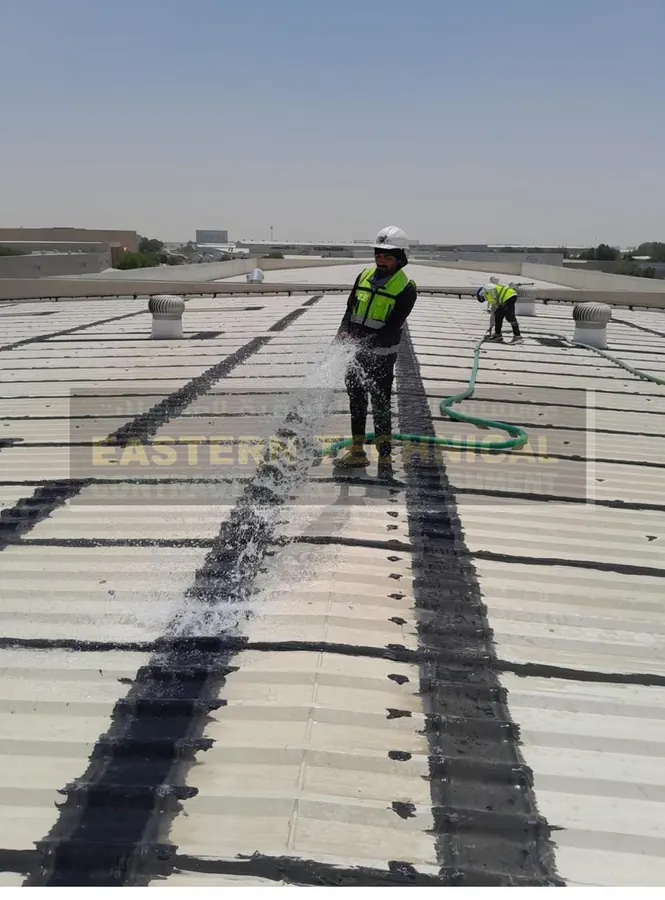
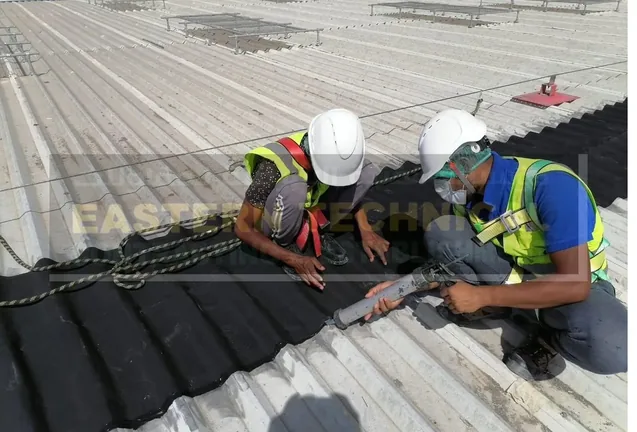
A practical maintenance scope often includes cleaning gutters and drain points, removing accumulated sand and debris, tightening or replacing failed fasteners, treating localized corrosion, renewing damaged sealants, repairing sheet laps, and restoring flashing around roof openings. However, isolated repairs are not always sufficient. Where leakage is repeated across multiple areas, a continuous waterproofing system can provide a more durable answer than patching one point at a time.
EPDM Waterproofing for Difficult Leak Points
EPDM rubberized waterproofing is particularly effective where metal roofs have complex details or repeated movement. It can be applied to gutters, penetrations, skylight curbs, smoke vents, joints, drain areas, and transitions where conventional sealants often fail. The material creates a flexible waterproof layer that can accommodate movement better than a rigid repair approach.
The performance of an EPDM-based system depends heavily on preparation. Loose rust, dust, failed coatings, moisture, and unstable old repairs must be addressed before installation. Edges, overlaps, and transitions require careful detailing. On a large warehouse roof, poor detailing at a small penetration can undermine otherwise sound work across a much larger area.
This is why maintenance should be treated as an engineered scope rather than a material purchase. The correct system depends on roof slope, sheet profile, drainage behavior, degree of corrosion, number of penetrations, expected movement, and whether the building can remain operational during the work.
Inspection Findings That Require Fast Action
Not every roof defect requires emergency intervention, but some conditions should not wait for the next annual review. Water stains spreading beneath roof sheets, dripping around electrical equipment, sagging gutter sections, loose or lifted sheets, severe corrosion around fasteners, and recurring leaks after minor repairs all indicate a need for immediate investigation.
Facility managers should also pay attention to internal symptoms. Condensation is sometimes mistaken for a roof leak, while a roof leak can be misdiagnosed as condensation. Water patterns, weather timing, insulation condition, and the location of openings must all be reviewed before selecting a repair. Treating the wrong cause wastes time and allows damage to continue.
After major rain, a focused roof check is valuable. Standing water in gutters, blocked downpipes, fresh debris around drains, and newly visible sheet movement can reveal problems before the next rainfall tests the roof again. In coastal locations such as Dammam and Jubail, salt-laden humidity can accelerate corrosion, making regular condition checks even more valuable.
Repair, Rehabilitation, or Replacement?
The best maintenance decision is rarely based on roof age alone. An older roof with localized defects and sound structural support may be a strong candidate for rehabilitation. Conversely, a newer roof with poor drainage design, widespread installation defects, or aggressive corrosion may need broader corrective work.
Localized repair is appropriate when damage is limited and the surrounding system remains stable. It can include replacing fasteners, repairing a small flashing area, restoring a gutter joint, or sealing a defined penetration. This option is cost-effective when the root cause is clearly contained.
Rehabilitation becomes more suitable when defects are recurring, repairs are spread across many areas, or the roof has reached a point where isolated patches create an inconsistent surface. A planned rehabilitation can address corrosion treatment, sheet repairs, waterproofing details, gutters, and vulnerable transitions as one coordinated scope. It generally requires more upfront planning, but it can reduce repeated callouts and disruption over time.
Replacement should be considered when metal sheets are extensively perforated, structural elements are compromised, drainage cannot be corrected within the existing configuration, or prior repairs have made the roof unreliable. Replacement is the largest intervention, so it should be supported by an accurate condition assessment and a plan for maintaining site operations during execution.
Building a Maintenance Schedule That Works
A roof maintenance schedule should reflect risk rather than follow a generic calendar. High-traffic warehouses, facilities with sensitive stock, buildings with multiple roof penetrations, and aging structures need closer attention than a simple, low-complexity shed. Inspections before the rainy period and after major weather events are practical starting points, with routine checks throughout the year for gutters, drains, and visible damage.
Documentation is essential. Each inspection should record defect locations, photographs, likely causes, repair recommendations, urgency, and any areas requiring monitoring. This creates a maintenance history that helps management distinguish between a one-time defect and a repeating system failure. It also improves budgeting because repairs can be prioritized before a small issue becomes an unplanned capital expense.
ETCE KSA approaches industrial roof work as a complete site solution, from inspection and diagnosis through fabrication, waterproofing installation, repair, and after-sales maintenance support. For operators managing active facilities, that single-contractor approach reduces coordination gaps between inspection findings and field execution.
The most useful question is not whether a roof leaks today. It is whether the roof has a controlled maintenance plan before the next period of heat, wind, sand, and rain exposes the same weak points again.
Related ETCE services
Need this checked on your own roof?
ETCE carries out industrial roof inspections, leak diagnosis, metal roof rehabilitation and EPDM waterproofing across Dammam, Al Khobar, Dhahran, Jubail, Riyadh and Jeddah.
Request a Roof Inspection WhatsApp UsMetal roof waterproofing across Saudi Arabia
ETCE is a metal roof waterproofing company in Saudi Arabia with its head office in Dammam. See our warehouse & factory roof waterproofing service or find your area: