A blocked roof drain rarely announces itself before it becomes a facility problem. Water begins ponding around a drain bowl, then finds weak seams, deteriorated sealant, corroded fasteners, roof penetrations, or gutter joints. For warehouse and factory operators, knowing how to maintain industrial roof drains is not a minor housekeeping task. It is a direct way to control leaks, corrosion, operational disruption, and avoidable repair costs.
Industrial roofs in Saudi Arabia face a demanding combination of intense UV exposure, heat cycles, windblown sand, dust accumulation, and occasional high-volume rainfall. A drain system that appears adequate during dry weather can fail quickly when debris, damaged strainers, poor slope, and aging waterproofing occur together. Maintenance must therefore cover more than clearing visible dirt. It must address drainage flow, drain body condition, roof waterproofing, and the downstream discharge route.
How to Maintain Industrial Roof Drains on Active Facilities
Start with a planned inspection schedule, then increase the frequency where the roof is exposed to dust, nearby construction debris, trees, bird activity, or repeated ponding. As a working baseline, inspect drains before the expected rainy period, after major wind or rain events, and at regular intervals throughout the year. Facilities with large low-slope roof areas or a known history of leakage may require monthly visual checks.
The inspection should begin from a safe roof access point. Confirm that the drain is visible, accessible, and not buried under sand, packaging debris, loose insulation, roof coating fragments, or accumulated leaves. A drain cannot perform at its rated capacity if water must pass through a layer of debris before reaching the strainer.
Do not treat drain cleaning as an isolated task. Examine the roof area feeding each drain. If water regularly sits around the same location after a normal rainfall or controlled water test, the issue may be insufficient fall, roof deflection, a blocked line, or a drain set too high relative to the finished roof surface. Removing debris may restore flow temporarily, but it will not correct a drainage design or substrate problem.
Clear strainers, bowls, and surrounding roof areas
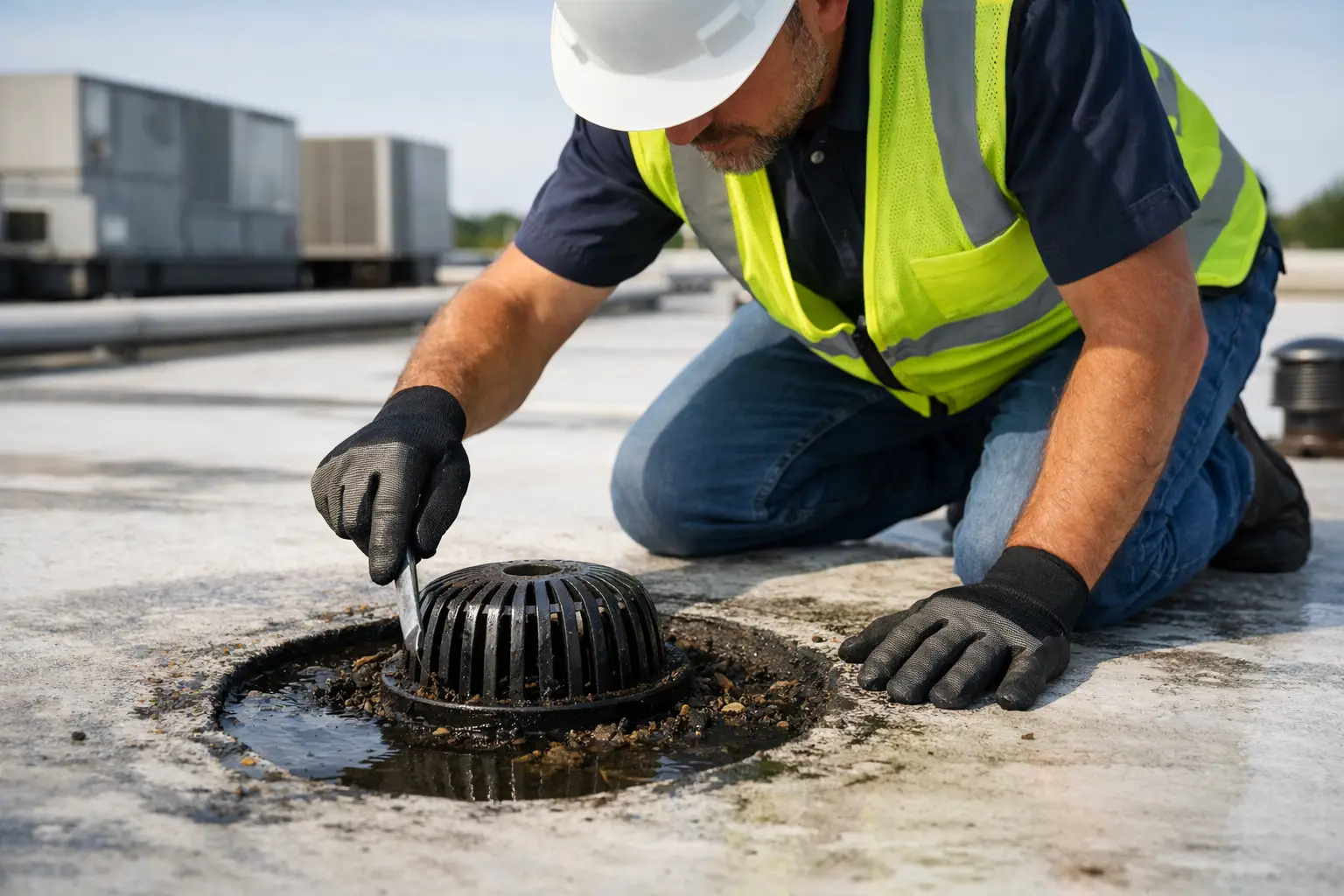
Remove loose debris by hand or with suitable non-damaging tools. Avoid sharp implements that can cut an EPDM membrane, puncture a coating, or damage the drain flange. Inspect the strainer or dome guard for cracks, missing sections, deformation, and loose fixings. A broken strainer allows larger debris into the line and creates a more difficult blockage below the roof surface.
Once the strainer is removed, inspect the bowl for sediment. Fine sand and roof debris can compact inside the bowl and reduce flow even when the drain opening looks clear from above. Clean the bowl thoroughly and confirm that water enters the outlet without backing up.
Where the drain connects to a vertical leader or horizontal pipe, use an appropriate flushing method to verify movement through the line. If water drains slowly, stop treating the issue as surface debris. The obstruction may be inside the pipe, at an offset, or at the outlet. Mechanical cleaning or controlled jetting may be required, depending on the pipe material, condition, and access arrangement.
Check the waterproofing at every drain point
Drain points are among the highest-risk locations on any industrial roof because several materials meet in a small area: metal deck or roof sheet, insulation or substrate, drain flange, membrane, sealant, and pipe connection. Movement from heat, vibration, corrosion, and structural deflection can break the watertight seal long before a visible interior leak appears.
Inspect the membrane or waterproofing detail around the drain for cracks, lifting edges, splits, blisters, punctures, loose termination bars, and shrinking sealant. On metal roofs, also inspect for rust around drain openings, cut edges, fixings, and fabricated gutters. Surface corrosion near a drain can spread beneath a failed waterproofing detail and weaken the roof assembly over time.
EPDM waterproofing is particularly effective around complex drain points when it is correctly detailed, bonded, and terminated. However, no membrane system should be expected to compensate for a blocked outlet or a distorted drain flange. The drainage path and waterproofing detail must work together.
Inspect Gutters, Scuppers, and Downpipes Too
A roof drain maintenance program is incomplete if it stops at the drain bowl. Water still needs a clear route through gutters, scuppers, downpipes, and discharge points. A blockage at any stage can force water back onto the roof or overflow against wall cladding and structural elements.
Check gutters for standing water, sediment buildup, open joints, corrosion, loose supports, and failed sealant. On long industrial buildings, compare water levels and debris patterns across the gutter length. Repeated sediment at one end may indicate inadequate slope, sagging, or a poorly located outlet.
Downpipes should be checked from top to bottom. Look for crushed sections, disconnected joints, corrosion at brackets, and discharge points that are blocked or too close to the building. If an outlet discharges onto a lower roof, that lower roof must have sufficient capacity to receive the additional water volume. This is a common oversight during repairs and extensions.
Use Water Testing to Separate a Drainage Problem From a Leak Problem
A controlled water test can help identify whether the issue is restricted flow, failed waterproofing, or both. The test should be planned carefully, especially on occupied facilities, because introducing water in the wrong area can create false results or disrupt operations below.
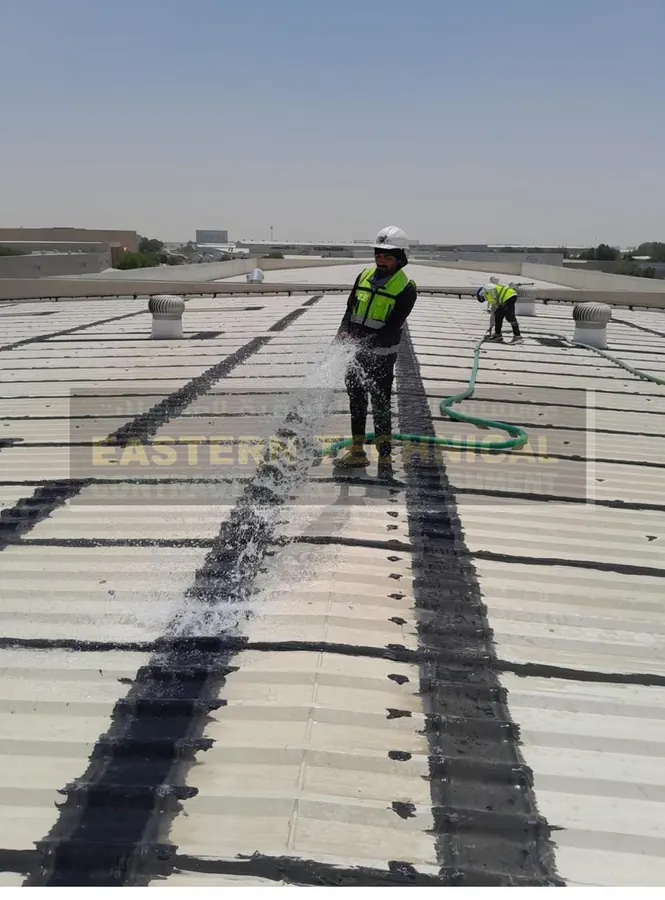
Apply water in sections, starting away from the drain and moving closer. Observe the travel path, time to drain, and any areas where water becomes trapped. Then test directly around the drain flange and connection detail. If water disappears through the drain but leakage occurs below, the drain body, pipe connection, or surrounding membrane may be compromised. If water does not reach the drain efficiently, investigate slope, obstructions, and roof surface deformation.
Document test locations with photos and mark them on a roof plan. Good records prevent repeat investigations and allow maintenance teams to see whether a localized defect is becoming a wider roof condition.
Know When Cleaning Is Not Enough
Routine cleaning is suitable for ordinary debris accumulation. It is not a substitute for repair when the drain assembly or surrounding roof has deteriorated. Escalate the issue when there is recurring ponding, repeated internal leakage, rust at drain openings, a loose or cracked flange, damaged membrane laps, or slow drainage that continues after surface cleaning.
The same applies when rainwater carries dark residue, roof fragments, or corrosion particles into the drain. These signs can indicate degradation in adjacent roof materials. Leaving the condition unresolved may allow moisture to enter insulation, corrode metal sheets, and expand the repair scope.
For aging warehouses, factories, and logistics facilities, a professional roof assessment should examine the drain point together with gutters, roof seams, penetrations, skylights, smoke vents, and the wider waterproofing system. ETCE KSA approaches these areas as connected building-envelope details, allowing the repair strategy to address the actual failure path rather than repeatedly patching the visible symptom.
Build a Drain Maintenance Record That Supports Decisions
A simple maintenance record adds discipline to drain work. For each drain, record the inspection date, condition of the strainer and bowl, debris removed, flow-test result, waterproofing observations, photographs, and repairs completed. Assign a drain number that matches a roof plan so teams can identify repeat problem locations without guesswork.
Trend data is valuable. If one drain requires cleaning far more often than others, investigate why. It may serve a larger roof area, sit beneath an equipment discharge point, receive windblown debris, or be positioned in a low area. The right corrective action could be a better guard, localized slope correction, line cleaning, or rehabilitation of the waterproofing detail.
Roof drain maintenance works best when it is treated as preventive asset protection, not an emergency response after water enters the building. Keep drains clear, verify flow beyond the roof surface, and repair deteriorated drain details before the next storm turns a manageable defect into a shutdown risk.
Related ETCE services
Need this checked on your own roof?
ETCE carries out industrial roof inspections, leak diagnosis, metal roof rehabilitation and EPDM waterproofing across Dammam, Al Khobar, Dhahran, Jubail, Riyadh and Jeddah.
Request a Roof Inspection WhatsApp UsMetal roof waterproofing across Saudi Arabia
ETCE is a metal roof waterproofing company in Saudi Arabia with its head office in Dammam. See our warehouse & factory roof waterproofing service or find your area: