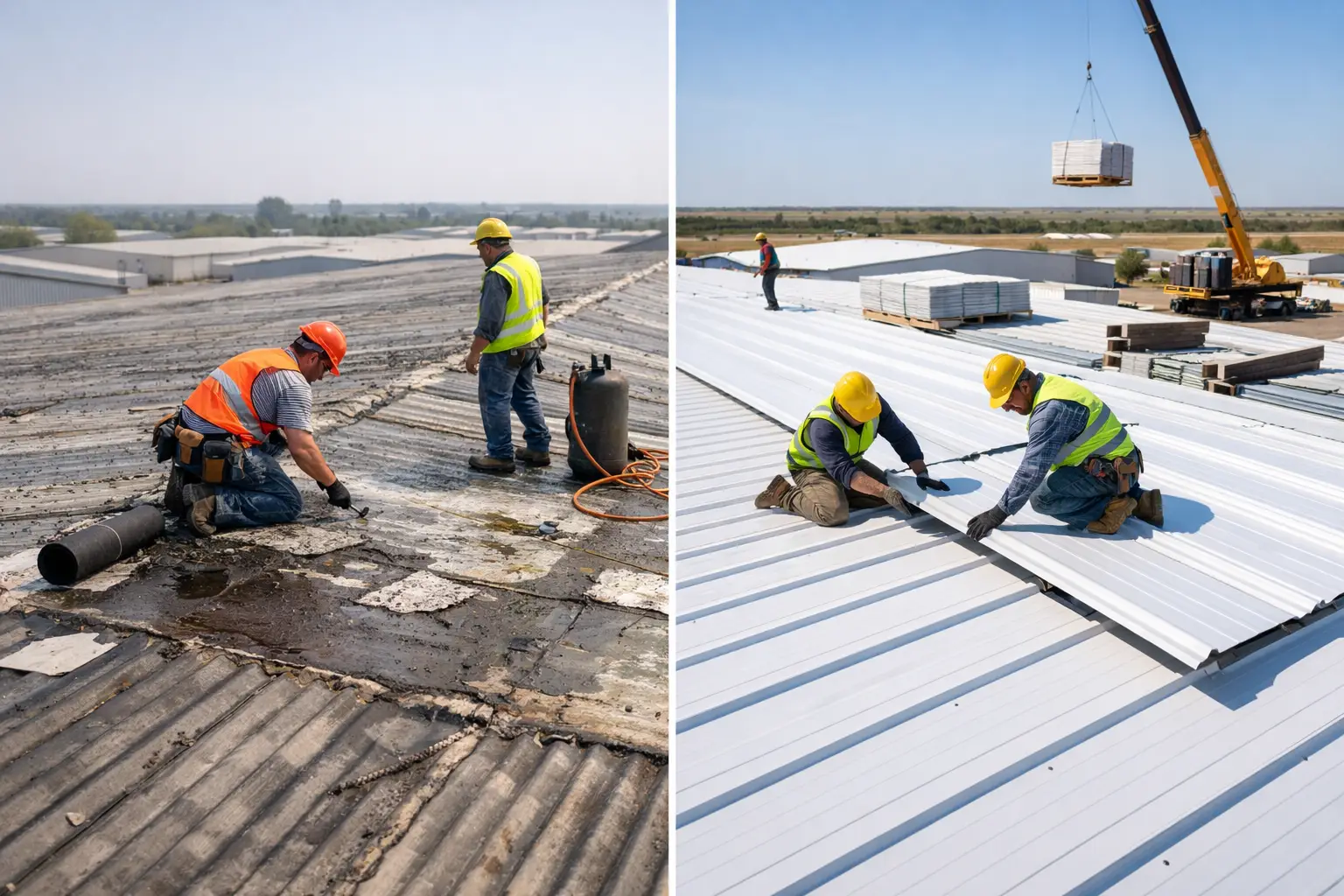
A leak over a loading area, production line, or stored inventory is rarely just a leak. Water can travel beneath metal sheets, collect around insulation, corrode fasteners, damage electrical systems, and interrupt operations long before the visible drip identifies the actual failure point. Warehouse roof repair versus replacement is therefore a building-performance decision, not simply a choice between a patch and a new roof.
For warehouse owners, facility managers, and operations teams, the right decision starts with a detailed site inspection. The objective is to determine whether the roof system still has serviceable structural life and can be rehabilitated, or whether deterioration has reached a point where replacement is the safer and more economical route.
Warehouse Roof Repair Versus Replacement: Start With the Failure
A roof should not be labeled as “failed” based on its age alone. Many industrial metal roofs in Saudi Arabia remain structurally sound after years of heat, UV exposure, wind-driven sand, and occasional heavy rainfall. Their main problems are often localized: failed fasteners, open side laps, deteriorated sealant, corroded flashings, damaged gutters, or leaking penetrations around ducts, skylights, smoke vents, and drain points.
These conditions can often be repaired or rehabilitated without removing the entire roof. An engineered waterproofing system can restore weather protection at vulnerable areas while avoiding the disruption, disposal, and operational risk of full replacement.
Replacement becomes more likely when the issue is not isolated. Widespread metal loss, recurring leaks across several elevations, unstable roof sheets, severely corroded purlins, extensive insulation damage, or a roof that no longer meets operational and safety requirements may indicate that repairs would only postpone a larger failure.
The key question is not, “Does the roof leak?” It is, “Why is it leaking, how far has the damage progressed, and will the proposed work stop the cause rather than cover the symptom?”
When Warehouse Roof Repair Makes Commercial Sense
Repair is usually the right route when the roof deck and supporting structure remain sound and the defects are concentrated around known failure points. It is particularly effective for warehouses with isolated water entry, early-stage corrosion, loose or failed fasteners, damaged ridge caps, leaking gutters, or deteriorated details around roof-mounted equipment.
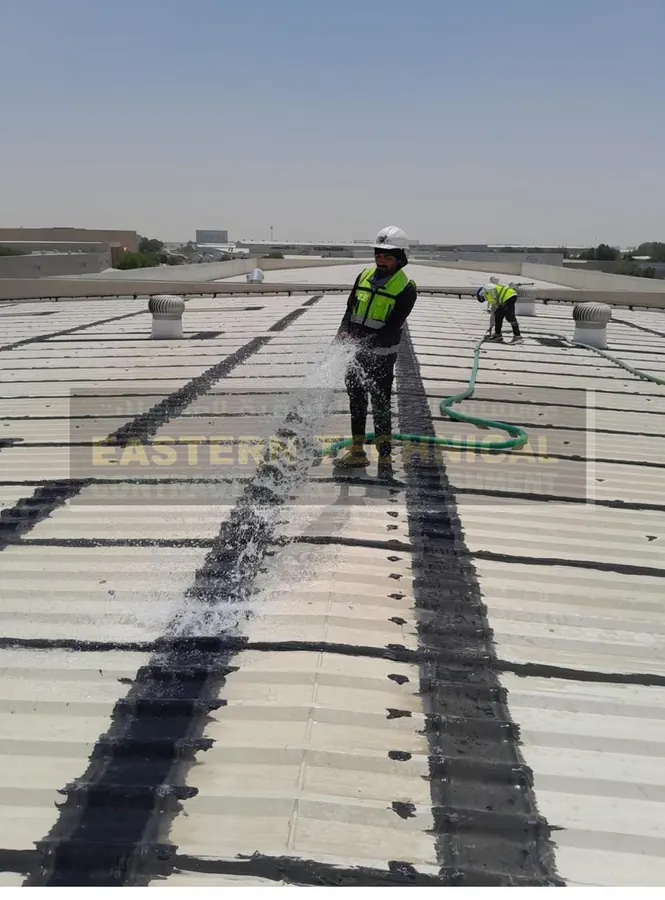
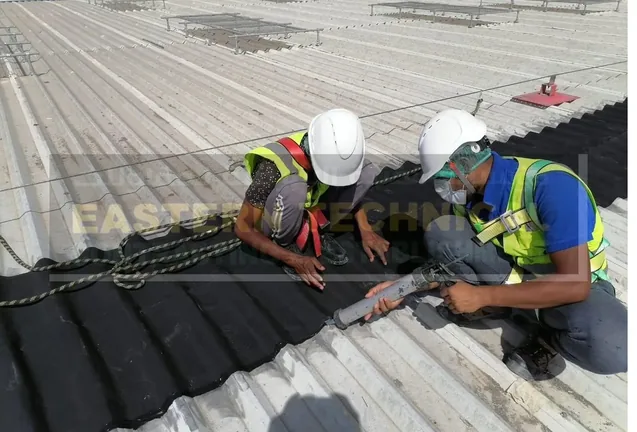
A well-planned repair scope should include surface preparation, corrosion treatment where required, replacement of failed fixings, repair of damaged sheet sections, and waterproofing of joints and penetrations. Applying sealant over dirt, rust, trapped moisture, or loose old material may reduce leakage temporarily, but it is not a dependable industrial repair strategy.
EPDM rubberized waterproofing is often suitable for difficult detailing on metal roofs. Its flexibility helps it accommodate movement around overlaps, transitions, equipment bases, skylights, gutters, and drain connections. This is valuable because metal roof leaks frequently develop where different materials meet or where thermal movement places repeated stress on conventional sealants.
Repair also has operational advantages. It can be phased by roof zone, coordinated around warehouse activity, and focused on critical areas first. For an active logistics facility or factory, this can reduce disruption to inventory movement, loading schedules, equipment access, and workforce safety.
That said, repair is not automatically the low-cost option. Repeated emergency callouts, temporary sealant applications, interior damage, and production interruptions can make an apparently inexpensive repair program expensive over time. A repair is commercially sound only when it creates a durable, maintainable roof condition.
Signs a Repair or Rehabilitation Program May Be Suitable
Repair is generally worth evaluating when leaks are limited to specific details, corrosion is mainly surface-level, roof sheets remain stable, and previous water entry has not compromised the supporting structure. It is also a strong option when the owner needs to extend the roof’s service life while planning a future capital project.
A detailed inspection should verify the condition of sheet laps, fasteners, ridge and eave details, gutters, roof penetrations, skylights, smoke vents, drain points, insulation, and internal signs of water travel. Water often enters in one location and appears inside the building several meters away. The visible stain is an indicator, not a diagnosis.
When Replacement Is the Better Long-Term Decision
Full replacement should be considered when the roof system has deteriorated beyond reliable local repair. This includes extensive perforation from rust, repeated sheet failure across broad areas, significant deformation, widespread water-damaged insulation, or structural concerns requiring engineering intervention.
If roof sheets are thin, brittle, heavily corroded, or unable to safely hold new fixings, waterproofing alone cannot restore their integrity. Similarly, if a facility has undergone multiple additions and alterations that created conflicting drainage paths and poorly detailed transitions, a replacement project may be the most practical way to correct the system as a whole.
Replacement can also be justified when a warehouse is being repurposed, expanded, or upgraded for higher-value operations. In that situation, the decision should account for future loading requirements, drainage capacity, access needs, daylighting, roof-mounted equipment, and the expected design life of the facility.
The trade-off is clear: replacement provides a reset in roof performance and design, but it requires a larger capital commitment, more detailed planning, and tighter control of site safety and weather exposure during execution. For active industrial sites, phasing and temporary protection measures are essential.
Replacement Does Not Remove the Need for Good Detailing
A new metal roof can still leak if gutters, penetrations, laps, skylights, and transitions are poorly designed or installed. The same high-risk areas must receive proper attention during replacement. Material quality matters, but execution at interfaces matters just as much.
This is why a replacement scope should cover more than roof sheets. It should assess drainage, gutters, flashing geometry, fastener systems, roof curbs, expansion movement, and waterproofing around every penetration. A complete solution protects the building envelope rather than treating the roof as separate from its critical details.
Compare Cost by Lifecycle, Not by Initial Quote
The lowest initial quote can create the highest long-term cost if it relies on surface-level patching and leaves corrosion, trapped moisture, or drainage defects unresolved. Conversely, replacing a roof that could be rehabilitated can tie up capital that would be better used for other facility priorities.
A practical comparison should include the cost of current and projected leak repairs, damage to stock and equipment, safety exposure, lost productivity, temporary protections, and the remaining service life expected from each option. It should also include how quickly the work can be completed without affecting operations.
For example, repairing localized failures and applying an engineered waterproofing system may provide several productive years of protection at a fraction of replacement cost. But if leaks return every rainy season across multiple zones, corrosion continues beneath the sheets, and maintenance teams are repeatedly responding to water entry, the roof may be consuming more operational cost than the repair budget shows.
The correct answer depends on evidence from the roof, not on a generic rule based on age or visible leak count.
Use an Inspection Report to Make the Decision Defensible
Before approving repair or replacement, request a roof assessment that documents conditions clearly. The report should identify leak locations, likely water paths, corrosion severity, failed components, drainage issues, structural observations, repair priorities, and recommended scope by area.
Photographs alone are useful but not sufficient. Decision-makers need a clear explanation of the failure mechanism, the consequence of leaving it untreated, and the expected service life of the proposed solution. This allows operations, maintenance, procurement, and ownership teams to compare options using the same technical basis.
For facilities in Dammam, Riyadh, and across KSA, inspection should also account for the local exposure profile: extreme heat, UV degradation, airborne dust, thermal movement, coastal moisture where applicable, and the effect of sand accumulation on drainage. These factors can accelerate failure at laps, gutters, fasteners, and exposed waterproofing details.
ETCE KSA approaches industrial roof work as an integrated scope, from inspection and diagnosis through fabrication, waterproofing installation, maintenance, and after-sales support. That single-contractor approach helps prevent gaps between the roof repair, metalwork, drainage, and penetration detailing teams.
Plan the Work Around Warehouse Operations
Whether the outcome is repair or replacement, the execution plan matters. Work areas should be isolated, access routes controlled, materials staged safely, and internal operations protected from dust, falling debris, and unexpected weather exposure. Roof activity must also be coordinated around loading bays, sensitive equipment, and occupied zones below.
A good contractor will sequence work by risk and operational priority. Active leak zones, compromised gutters, and areas above critical inventory or equipment should be addressed first. Planned maintenance inspections should then follow, especially before periods of expected rainfall.
The most useful next step is a condition-based inspection that separates urgent leak control from long-term roof planning. A warehouse roof does not need to be replaced simply because it is old, and it should not be repeatedly patched simply because replacement requires planning. The right decision is the one that protects the building, keeps operations moving, and delivers a service life that justifies the investment.
Related ETCE services
Need this checked on your own roof?
ETCE carries out industrial roof inspections, leak diagnosis, metal roof rehabilitation and EPDM waterproofing across Dammam, Al Khobar, Dhahran, Jubail, Riyadh and Jeddah.
Request a Roof Inspection WhatsApp UsMetal roof waterproofing across Saudi Arabia
ETCE is a metal roof waterproofing company in Saudi Arabia with its head office in Dammam. See our warehouse & factory roof waterproofing service or find your area: