
A warehouse roof rarely fails without warning. Water stains below a roof penetration, rust around a fastener, loose flashing at a skylight, or standing water in a gutter are all early signs that require action. This warehouse roof leak prevention checklist helps facility teams identify those signs before they become stock damage, electrical risk, production disruption, or costly structural repairs.
For metal roofs, sandwich panels, corrugated sheets, and aging single-skin systems, prevention is not a single coating application or a once-a-year visual walk. It is a planned inspection and maintenance process that focuses on the points where water enters first: laps, screws, gutters, roof-mounted equipment, drains, skylights, smoke vents, and transitions between materials.
Start With a Safe, Documented Roof Inspection
Inspect the roof at least twice a year, ideally before and after the rainy season, and after significant wind, sandstorms, or heavy rainfall. A roof can look intact from ground level while sealants have separated, fastener washers have failed, or water has started tracking beneath metal sheets.
Before anyone accesses the roof, establish safe access, edge protection, and a controlled walking route. Metal roof sheets and sandwich panels can be damaged by unnecessary foot traffic. Teams should avoid stepping on unsupported sheet areas, skylight surfaces, weak insulation zones, or corroded panels. If the roof has active leaks, wet surfaces, or visibly weakened sections, inspection should be completed by trained personnel with the right safety controls.
A useful inspection report does more than list leaks. It records the exact roof area, photographs the defect, identifies the likely entry point, describes the affected roof component, and ranks the urgency. This allows facility managers to separate immediate repairs from planned rehabilitation work and to track recurring failures over time.
Warehouse Roof Leak Prevention Checklist for Critical Areas
1. Check metal sheets, panel joints, and lap seams
Sheet overlaps and panel joints are common leak paths, especially on roofs exposed to intense heat, UV radiation, wind-driven rain, and thermal movement. Look for opened laps, missing sealant, cracked butyl tapes, lifted sheet edges, and visible gaps at side laps or end laps.
Pay close attention to areas where roof geometry changes. Ridges, eaves, valleys, parapet transitions, and connections between old and newer roof sections experience more movement than broad field areas. A small opening in one of these locations can allow water to travel a long distance before it appears inside the warehouse.
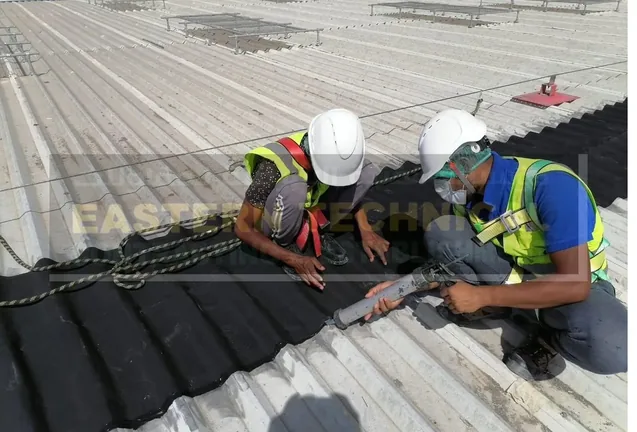
Do not assume that applying more sealant over a dirty or failed joint is a durable repair. The joint must be cleaned, dried, assessed for movement and corrosion, then repaired with a compatible waterproofing detail. Where metal sheets are heavily deteriorated, localized patching may only provide short-term relief. Rehabilitation or an engineered membrane system may be the better decision.
2. Inspect fasteners and corrosion
Every exposed fastener is a potential water entry point. Over time, screws can back out, washers can harden or split, and corrosion can widen the hole around the fastener. Check for missing screws, loose fixings, tilted fasteners, rust streaks, damaged washers, and enlarged holes in the metal sheet.
Corrosion requires more than cosmetic attention. It reduces metal thickness and can compromise the roof’s ability to hold fasteners securely. Surface rust may be treatable after proper cleaning and preparation, but perforated sheets, advanced corrosion at laps, and weak roof framing require a broader repair scope.
Also inspect cut edges, drilled openings, and roof areas where incompatible metals meet. These locations can corrode faster, particularly when moisture and debris remain trapped. Correct drainage and properly detailed waterproofing reduce the conditions that allow corrosion to continue.
3. Examine penetrations and roof-mounted equipment
Most warehouse leaks occur around penetrations rather than in the middle of an intact roof sheet. Inspect every pipe, duct, cable tray support, exhaust outlet, HVAC curb, antenna base, and equipment frame that passes through or sits on the roof.
The critical question is whether the waterproofing detail can move with the roof. Metal roofs expand and contract significantly under Saudi Arabia’s heat. A rigid sealant-only repair around a moving penetration may crack or separate within a short period. Flexible EPDM-based waterproofing details are often suitable for irregular shapes, difficult corners, and movement-prone penetrations when properly prepared and installed.
Check for loose clamps, open collars, failed flashing, unsupported conduits, and makeshift repairs left by third-party service crews. Any contractor working on rooftop equipment should restore the waterproofing detail before leaving the site. A new cable or pipe installation that is not properly sealed can create a direct path for water into the building.
4. Clear and test gutters, drains, and downpipes
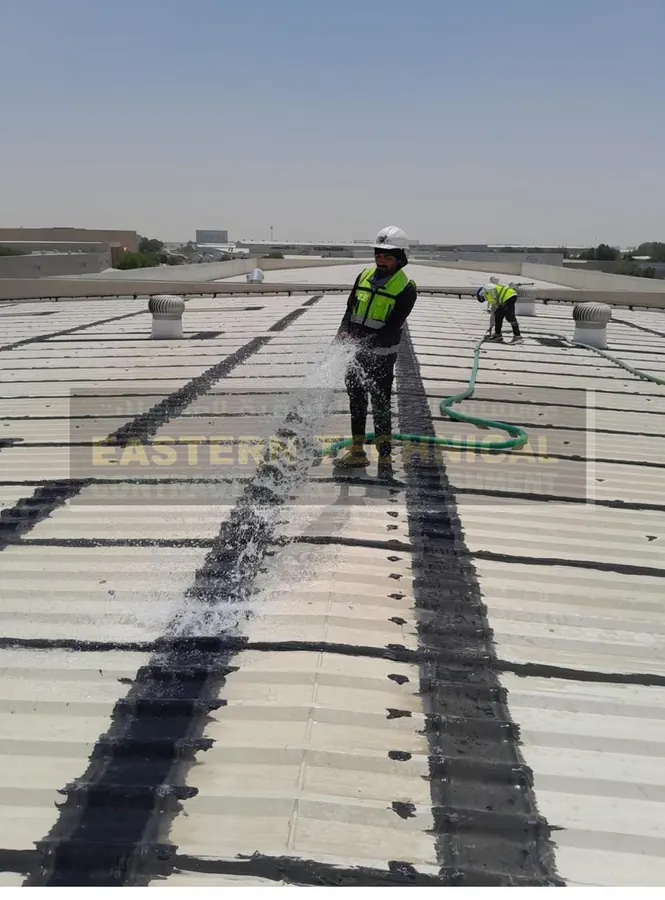
Water must leave the roof quickly. Blocked gutters and undersized or poorly maintained drain points allow water to pond, overflow behind flashings, and enter through laps or corroded areas. Sand, dust, packaging debris, bird nests, and loose sealant frequently build up in drainage routes.
Remove debris from gutters, valleys, scuppers, drain bowls, strainers, and downpipes. Then test the drainage path with controlled water flow. A drain that appears clear at the roof level may still be blocked lower in the downpipe. Check for cracked gutter joints, rusted gutter bottoms, failed outlet connections, sagging sections, and overflow staining on external walls.
Standing water is not always caused by a blocked drain. It can indicate poor roof slope, deflected sheets, settlement, or drainage capacity that no longer suits the building’s roof area. These conditions should be assessed as design and rehabilitation issues, not repeatedly treated with temporary sealant.
5. Inspect skylights, smoke vents, and access hatches
Skylights and smoke vents combine multiple materials, fasteners, frames, gaskets, and flashing details. They are therefore high-risk leak locations. Look for cracked glazing, brittle gaskets, loose frames, failed perimeter sealant, damaged curb flashing, and water marks around interior openings.
Smoke vents and access hatches also need functional checks. Their lids must close correctly, seals must compress evenly, and the surrounding curb must remain watertight. Repairs must not interfere with emergency operation, ventilation requirements, or safe roof access.
6. Review interior warning signs after rainfall
A roof inspection should include the warehouse interior. Immediately after rainfall, walk beneath known leak zones and inspect roof framing, ceiling areas, electrical rooms, storage aisles, and areas below rooftop equipment. Look for damp insulation, dripping, stains, mold growth, rusted purlins, peeling coatings, or water collecting on equipment.
The visible drip may not be directly below the entry point. Water can travel along sheet laps, insulation layers, purlins, conduits, and structural members. Interior evidence should be matched with roof observations before repair work begins. This is why diagnosis matters: treating only the point where water appears often leaves the actual defect unresolved.
Set Repair Priorities Based on Operational Risk
Not every defect needs the same response. An active leak above electrical equipment, stored goods, production lines, or critical logistics zones requires immediate containment and repair. Open penetrations, loose sheets, damaged skylight flashing, and blocked primary drains should also be treated as urgent.
Minor surface corrosion, aging sealant without active leakage, and isolated fastener deterioration can often be scheduled as preventive work. However, small defects should not be allowed to accumulate across a large roof area. When repeated repairs occur at multiple laps, penetrations, and gutters, the building may be signaling that isolated patching is no longer cost-effective.
The practical choice depends on roof age, corrosion extent, expected building use, access conditions, and the cost of downtime. A targeted repair is appropriate when defects are isolated and the surrounding roof remains sound. A complete EPDM waterproofing system or metal roof rehabilitation is more appropriate when leaks are recurring, details are failing across wide areas, or the existing roof needs a longer service strategy.
Build Prevention Into the Maintenance Calendar
Assign roof inspections to a defined maintenance calendar rather than waiting for a water event. Keep drawings, repair records, inspection photographs, and drainage-cleaning dates in one file. This gives future teams a clear history of recurring locations and makes budgeting more accurate.
ETCE KSA supports industrial facilities with site inspections, detailed leak diagnosis, EPDM waterproofing for difficult roof details, metal roof rehabilitation, gutter repairs, fabrication, installation, and ongoing maintenance support. For operating warehouses, the goal is not merely to stop the current drip. It is to keep water, corrosion, and unplanned downtime from gaining a foothold in the building.
Related ETCE services
Need this checked on your own roof?
ETCE carries out industrial roof inspections, leak diagnosis, metal roof rehabilitation and EPDM waterproofing across Dammam, Al Khobar, Dhahran, Jubail, Riyadh and Jeddah.
Request a Roof Inspection WhatsApp UsMetal roof waterproofing across Saudi Arabia
ETCE is a metal roof waterproofing company in Saudi Arabia with its head office in Dammam. See our warehouse & factory roof waterproofing service or find your area: