A roof leak over a production line is never just a roof problem. It can halt operations, damage inventory, create slip hazards, and accelerate corrosion in the structure below. That is why an industrial roof repair checklist matters – not as paperwork, but as a practical control measure for warehouses, factories, logistics buildings, and large commercial assets.
Most industrial roofs do not fail in one dramatic event. They fail at details first. A loose fastener, a split lap joint, an aging skylight curb, blocked gutters, failed sealant at penetrations, or corrosion around drain points can all start small and then spread under heat, UV, rain, and movement. If your building has a metal roof, sandwich panel system, corrugated sheets, or aging waterproofing, the right inspection and repair sequence makes the difference between a contained repair and a much larger rehabilitation project.
What an industrial roof repair checklist should actually do
A useful checklist is not a generic list copied from a manual. It should help your maintenance or project team answer three operational questions. First, where is water entering or likely to enter? Second, what is the current condition of the roof system and its weak points? Third, what repair scope will stop the issue for the long term instead of only masking symptoms?
That means the checklist must go beyond visible leaks. Water often travels. The stain inside the building may be meters away from the actual entry point, especially on metal roofs with laps, purlins, and fastener lines. An effective inspection process tracks pathways, identifies hidden deterioration, and separates urgent repairs from items that can be planned.
Industrial roof repair checklist: start with safety and access
Before any condition assessment begins, confirm safe roof access and work controls. This is basic, but it is often rushed on active industrial sites. Fragile skylights, wet roof sheets, loose panels, and incomplete walk paths create risk for both inspection teams and maintenance crews.
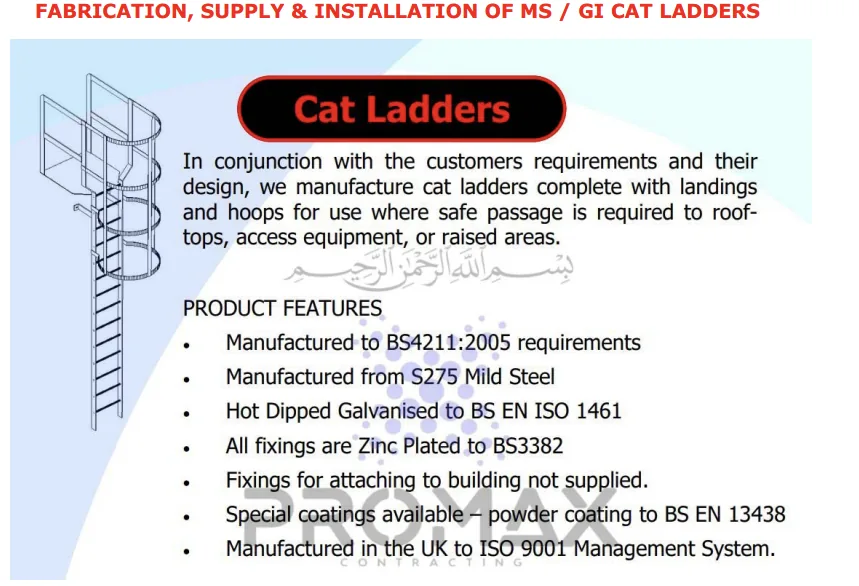
Check access ladders, anchor points, edge protection requirements, and roof load limitations. If the roof includes old sheets, corroded zones, or unsupported sections, mark them clearly before anyone walks the area. The inspection is only useful if it can be completed without exposing personnel to preventable hazards.
At this stage, it also helps to review previous leak complaints, maintenance logs, and repair history. Repeated patching in the same area usually signals a failed detail, incompatible materials, or a broader system issue that was never fully corrected.
Inspect the roof covering and sheet condition
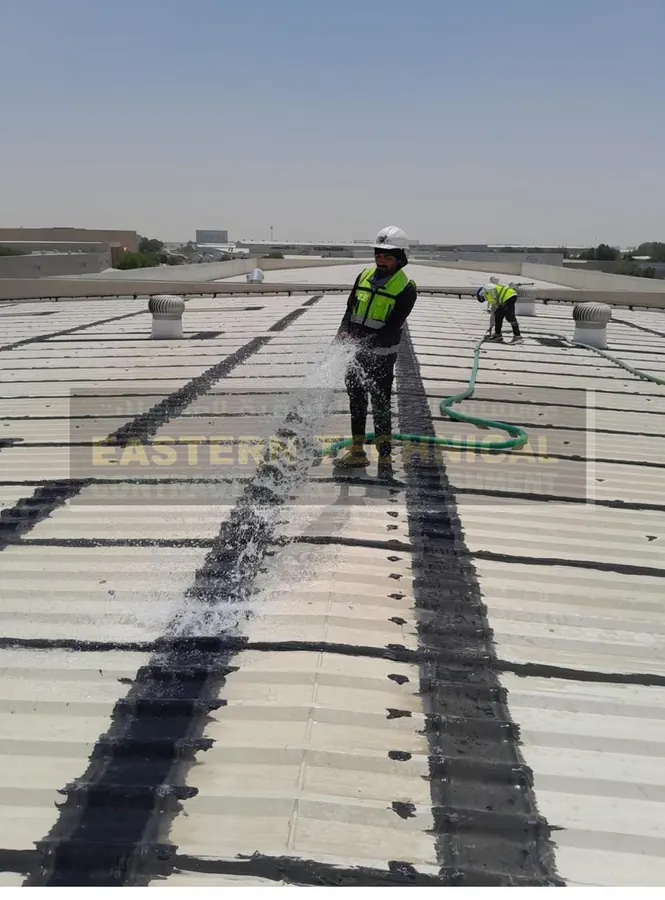
The field area of the roof usually shows the first broad signs of age and exposure. On metal and sheeted roofs, inspect for corrosion, coating breakdown, punctures, loose or backed-out fasteners, deformed panels, and movement at side laps and end laps. Even when leaks have not started yet, these conditions reduce the roof's ability to resist wind, moisture, and thermal movement.
Surface rust should never be treated as only cosmetic on industrial buildings. In the early stage, localized cleaning, preparation, and protective treatment may be enough. Once metal loss begins around fixings, overlaps, or low points, the repair strategy changes. You may need local sheet replacement, reinforcement, or a waterproofing system that bridges and protects vulnerable sections.
For sandwich panels, inspect joint integrity, seal condition, panel alignment, and any signs of moisture intrusion at seams. Water entering panel joints can travel internally and appear elsewhere, which makes diagnosis more technical than a simple visual check.
Pay close attention to laps, fasteners, and penetrations
Most recurring leaks on industrial roofs come from details, not open roof spans. Laps should be checked for separation, failed sealant, dirt buildup, and signs of capillary ingress. Fasteners should be reviewed for backing out, washer failure, corrosion, and enlarged holes caused by movement or overtightening.
Penetrations deserve a separate inspection pass. This includes ducts, vents, equipment supports, cable entries, pipe penetrations, smoke vents, and skylight curbs. These areas combine movement, water flow, and multiple materials, which is why they fail early if detailing is poor or aging. Cracked sealant, brittle flashings, open edges, and patch-on-patch repairs are all warning signs.
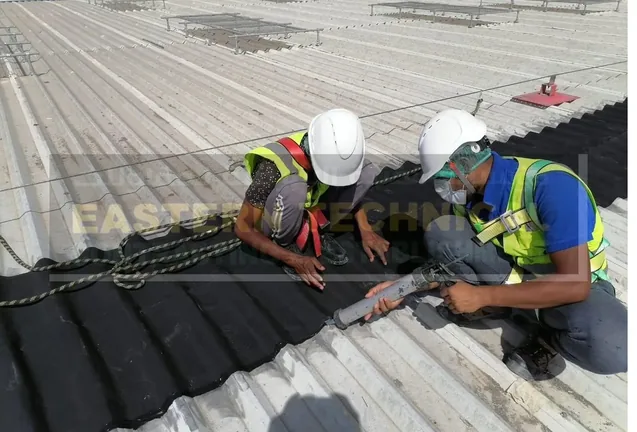
This is also where material choice matters. A simple sealant touch-up may hold briefly, but difficult leak points often need a more engineered treatment. EPDM-based waterproofing is commonly used at penetrations, gutters, skylights, and irregular roof details because it can create a more continuous and durable barrier where sheet joints alone are not enough.
Check drainage paths before the next rain does
Poor drainage can turn a repairable roof into a repeating maintenance problem. Your industrial roof repair checklist should include gutters, downspouts, valley gutters, sumps, drain outlets, and any low points where water ponds.
Start with blockage and debris, but do not stop there. Check for corrosion in gutters, failed joints, poor falls, overflow marks, loose brackets, and cracks around outlets. On large industrial roofs, one weak gutter joint can feed water into wall lines, insulation zones, or internal building elements long before the source is obvious from below.
Ponding water deserves attention even on roofs that are not formally low-slope membrane systems. Standing water increases dirt accumulation, stresses joints, accelerates corrosion, and exposes weaknesses in coatings and fasteners. If ponding is repeated, the repair may require slope correction, local fabrication, or drain-point redesign rather than another surface patch.
Review edges, upstands, and roof-to-wall transitions
Perimeters and vertical transitions are common failure points on aging industrial buildings. Inspect parapet connections, roof edges, ridge details, wall flashings, headwall conditions, and expansion areas. Wind uplift and thermal cycling often open these zones gradually.
Look for lifted flashings, incomplete terminations, missing closures, open joints, and water staining below edge conditions. If a roof meets a wall or changes level, assume it needs closer review. These areas usually demand fabrication accuracy and proper waterproofing continuity, not improvised site patching.
Identify whether the problem is local or systemic
This is where experienced judgment matters. Not every roof needs full rehabilitation, and not every leak can be solved with isolated repairs. A checklist should help decision-makers classify the issue correctly.
A local problem typically involves one failed detail, one damaged section, or one isolated drainage fault with surrounding roof areas still in serviceable condition. A systemic problem shows repeated leaks in multiple zones, widespread corrosion, broad fastener failure, aging joints across the roof, or a pattern of reactive repairs that keeps growing year after year.
If the issue is systemic, piecemeal repair may only delay larger costs. In those cases, the better route may be sectional rehabilitation, waterproofing upgrades at key details, or a coordinated repair plan completed in phases to reduce disruption.
Document repair priorities and execution constraints
A strong inspection report does more than list defects. It ranks them. For industrial sites, repair planning should separate immediate leak-stoppage items from medium-term corrective work and long-term life extension measures.
Urgent items usually include active leaks over operations, unsafe sheet conditions, deteriorated penetrations, failing gutters, and loose roof elements that could worsen under wind or rain. Planned items may include corrosion treatment, fastener replacement programs, joint resealing, and targeted waterproofing at known weak points.
Execution constraints should also be recorded. Can work be done during operating hours? Are there heat-sensitive processes below? Does access require shutdown coordination? Will fabrication be needed before installation? The repair method is only practical if it fits the building's operational reality.
On large sites, that coordination is often where value is won or lost. A contractor that can inspect, diagnose, fabricate details, install the repair, and support ongoing maintenance reduces handoff risk and shortens response time. That matters when the roof issue is affecting production or stock protection.
A practical industrial roof repair checklist for decision-makers
If you need a working field reference, focus on these checkpoints during inspection: roof access safety, visible leak evidence, sheet condition, corrosion level, fastener integrity, lap condition, penetrations, skylights, smoke vents, gutters, drain points, edge details, roof-to-wall transitions, previous repair performance, and signs of recurring water paths.
The key is not to treat each item in isolation. A backed-out fastener near a corroded lap beside a blocked gutter is not three small defects. It is one leak system forming. That is why experienced roof repair teams inspect the roof as an interacting assembly rather than a collection of separate parts.
For industrial buildings in harsh climates, especially where heat, dust, moisture, and UV are constant stress factors, durability depends on selecting repair methods that match the failure mechanism. ETCE KSA typically approaches these roofs with that logic first – diagnose accurately, repair the weak detail properly, and protect the surrounding system so the same issue does not return at the next weather event.
A good checklist does not make roof problems disappear. What it does is bring order to the decision. When your team knows what to inspect, how to classify risk, and where durable repair is actually needed, you can act before a small defect turns into downtime, damaged stock, or a much larger roof package.
Related ETCE services
Need this checked on your own roof?
ETCE carries out industrial roof inspections, leak diagnosis, metal roof rehabilitation and EPDM waterproofing across Dammam, Al Khobar, Dhahran, Jubail, Riyadh and Jeddah.
Request a Roof Inspection WhatsApp UsMetal roof waterproofing across Saudi Arabia
ETCE is a metal roof waterproofing company in Saudi Arabia with its head office in Dammam. See our warehouse & factory roof waterproofing service or find your area: