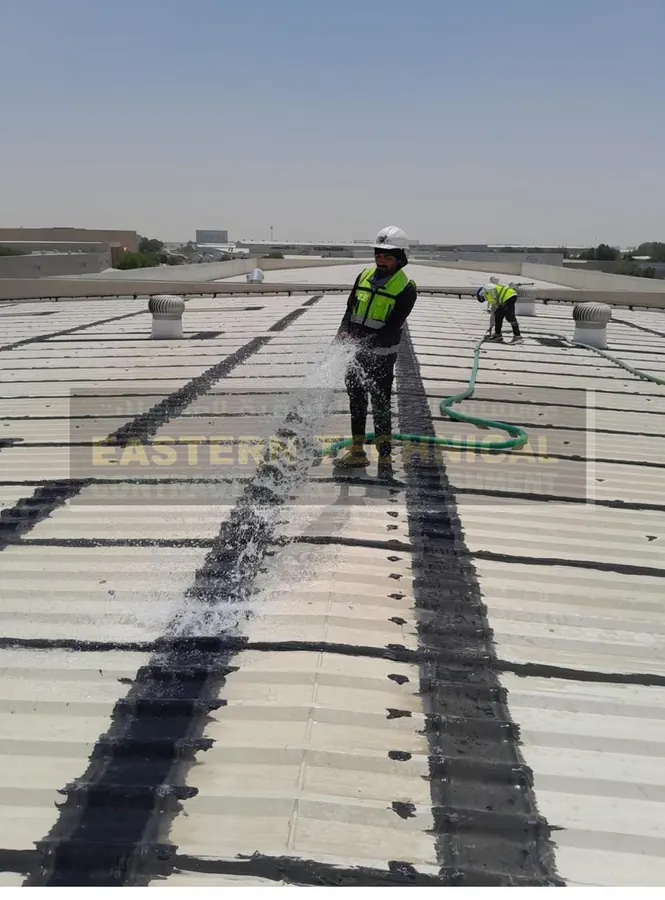
A metal roof rarely starts failing across the whole surface at once. In most industrial buildings, leaks begin at the weak details – end laps, fasteners, gutters, skylights, penetrations, ridge lines, and poorly handled repair patches. That is why metal roof waterproofing Dammam facility managers ask for should never be treated as a simple coating job. On warehouses, factories, and logistics buildings, the right solution depends on where water enters, how the roof moves under heat, and how much corrosion has already developed below the sheet line.
In Dammam, roof performance is shaped by heat, UV exposure, wind-driven dust, humidity, and aging sheet assemblies that have been repaired multiple times over the years. A roof may look serviceable from ground level and still be allowing water intrusion around screw points or panel joints. Once that moisture reaches insulation, purlins, ceiling areas, electrical routes, or stored goods, the cost is no longer just a roof problem. It becomes an operations problem.
Why metal roofs leak before they fail structurally
Industrial metal roofs are built to cover large spans efficiently, but they are full of movement points. Sheet expansion and contraction place stress on laps and fasteners. Sealants dry out. Screws loosen. Washers crack. Older patching compounds harden and separate from the metal. In many buildings, the drainage layout also becomes part of the problem, especially where gutters hold standing water or where slope is too shallow for fast discharge.
This is why one leak during a storm should not be treated as an isolated defect without inspection. Water often travels along sheet profiles, framing members, or insulation before it becomes visible inside the building. The visible drip point may be several meters away from the actual entry point.
For warehouse and factory owners, the practical issue is not whether the roof can be patched quickly. It is whether the repair method can handle movement, weather exposure, and repeated wetting at the same detail. A cheap fix at the wrong location usually creates a second repair cycle, then a third.
What effective metal roof waterproofing in Dammam should include
A proper waterproofing strategy starts with diagnosis, not product selection. On active industrial sites, the roof must be assessed for sheet condition, corrosion levels, fastener integrity, open laps, failed sealant lines, gutter condition, roof penetrations, skylight interfaces, and any previous repair layers. Moisture entry at duct bases, smoke vents, curbs, drains, and side laps should be checked carefully because these are common repeat-failure points.
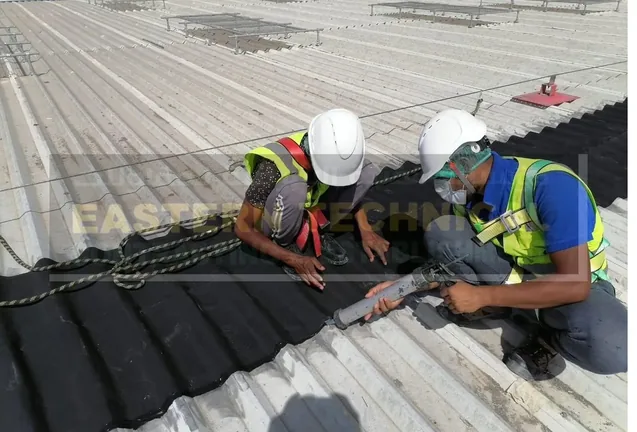
Once the roof condition is clear, the waterproofing method should match the actual defect pattern. This is where many projects go wrong. Some roofs need localized EPDM detailing and reinforcement at critical leak points. Some require rehabilitation across large sections of aging sheet. Others need fabrication and replacement of damaged flashings, drainage corrections, or structural repair before waterproofing can even begin.
For industrial buildings, the best-performing systems are usually the ones that address both the field area and the difficult details. A broad roof surface may remain intact while every penetration and lap is failing. In that case, waterproofing success depends on detail treatment more than surface coverage.
EPDM for metal roof waterproofing Dammam sites can trust
EPDM-based waterproofing is especially effective on metal roofs with recurring leaks at movement zones and complex details. The material handles thermal movement better than many brittle patching methods, which matters on sheet roofs exposed to intense daily heat cycles. When applied correctly, it can seal around penetrations, curbs, gutters, overlaps, and transition areas where standard sealant-only repairs tend to break down.
That does not mean EPDM is a universal answer for every roof section. If the substrate is heavily corroded, unstable, or poorly fastened, the base condition has to be corrected first. Waterproofing should never be used to hide failing metal, rotted supports, or drainage defects. Good contractors know the difference between a roof that needs sealing and a roof that needs rehabilitation before sealing.
On older warehouses, EPDM is often most valuable at the details that historically keep leaking even after multiple repairs. End laps, roof penetrations, gutters, drain points, and skylight perimeters are typical examples. These are the areas where movement, ponding, and workmanship errors usually combine.
Common failure points on industrial metal roofs
Facility teams often assume the sheet itself is the problem, but leak entry is more often tied to interfaces. Fastener lines are a common source, especially where aging washers have shrunk or cracked. Side laps and end laps are another major risk, particularly when previous sealants have hardened or when the sheets were installed with inconsistent overlap pressure.
Gutters deserve special attention. In many industrial buildings, the gutter is both a drainage element and a leak channel. Once corrosion begins inside the gutter or at the connection between gutter and roof edge, water can backtrack into the building envelope. Overflow also becomes more likely during intense rain events.
Penetrations are another frequent problem. Pipes, exhaust bases, duct supports, vents, cable routes, and mechanical curbs interrupt the roof plane and create detail work that may not age at the same rate as the surrounding metal. A waterproofing contractor with real industrial experience will inspect these transitions closely instead of treating the roof as one flat surface.
Repair, overlay, or full rehabilitation?
There is no honest one-size-fits-all answer here. It depends on roof age, corrosion depth, number of active leak points, substrate condition, and operational constraints inside the facility.
If the roof is generally sound and leaks are concentrated at identifiable details, targeted waterproofing repairs may be the smartest route. This approach controls cost and reduces disruption, provided the diagnosis is accurate.
If the roof has widespread joint failure, recurring leaks across multiple zones, and patchwork from several previous interventions, a broader rehabilitation plan is usually more cost-effective than repeated spot repairs. At that stage, the issue is not just water entry. It is the declining reliability of the whole roof assembly.
Full replacement may still be necessary in some cases, but many industrial clients prefer rehabilitation when the structure can be preserved and downtime must be limited. That is where an engineered contractor adds value – by separating salvageable roof areas from sections that need replacement, then building a scope around actual conditions instead of assumptions.
What industrial clients should expect from a contractor
For a warehouse or factory roof, waterproofing is not just a material supply exercise. The contractor should inspect the roof in person, document failure points, identify probable water paths, and explain whether the recommendation is repair, reinforcement, or rehabilitation. If drainage, flashing fabrication, or metal replacement is needed, that should be built into one coordinated scope.
Speed matters, but industrial clients should be careful with teams that promise immediate coating without technical review. Fast response is valuable only when paired with sound diagnosis. A contractor that can inspect, fabricate, install, and maintain under one service umbrella reduces coordination gaps and usually delivers better long-term performance.
ETCE KSA works in this contractor-first model because industrial roofs do not fail in neat categories. A leak may involve sheet defects, flashing issues, drainage limitations, and failed detail waterproofing at the same time. Treating all of that through one accountable team is often the difference between a temporary fix and a durable result.
How to judge whether a waterproofing proposal is serious
A serious proposal should identify defect locations, not just quote a generic roof treatment. It should explain substrate preparation, corrosion handling, detail treatment, material compatibility, and how critical areas such as gutters, penetrations, skylights, and drain points will be sealed. If the roof has active rusting or damaged components, the proposal should state whether those elements will be repaired or replaced before waterproofing begins.
It should also reflect site reality. On active industrial buildings, access planning, safety controls, work sequencing, and protection of operations matter. Waterproofing that looks correct on paper can still fail if the contractor cannot execute cleanly on a live facility.
The best metal roof waterproofing Dammam projects are not the ones with the broadest claims. They are the ones with the clearest diagnosis, the right repair depth, and a method that respects how industrial roofs actually age.
A roof does not need marketing language. It needs the right fix at the right detail, installed before the next rain turns a maintenance issue into a shutdown.
Related ETCE services
Need this checked on your own roof?
ETCE carries out industrial roof inspections, leak diagnosis, metal roof rehabilitation and EPDM waterproofing across Dammam, Al Khobar, Dhahran, Jubail, Riyadh and Jeddah.
Request a Roof Inspection WhatsApp UsMetal roof waterproofing across Saudi Arabia
ETCE is a metal roof waterproofing company in Saudi Arabia with its head office in Dammam. See our warehouse & factory roof waterproofing service or find your area: