A warehouse roof rarely fails all at once. It starts at a lap joint that opens under thermal movement, a fastener that backs out, a curb flashing that cracks, or a gutter corner that holds standing water longer than it should. In industrial facilities, roof leak repair Saudi Arabia is not just about stopping water. It is about protecting stock, electrical systems, insulation performance, steel structure, and daily operations before a small entry point turns into corrosion, downtime, and repeated callouts.
For factories, logistics buildings, sheds, and large storage assets, the wrong repair approach is often more expensive than the leak itself. A quick patch may hold for a few weeks, but if the roof has movement, rust, failed sealant lines, damaged penetrations, or poor drainage, the leak usually comes back at the next rain event or washdown cycle. The repair has to match the roof type, the condition of the metal, and the way the building is actually used.
Why roof leaks behave differently in industrial buildings
Industrial roofs are exposed to more stress than many standard commercial buildings. Wide roof spans, heat gain, UV exposure, sand, dust loading, ponding near gutters, and rooftop service activity all accelerate wear. On metal roofs and sandwich panel systems, expansion and contraction are major factors. The roof sheets move, the screws work loose, sealants lose elasticity, and weak points around penetrations start opening up.
That is why leak tracing is not always straightforward. Water may enter at one point and travel along purlins, panel joints, insulation layers, or ceiling cavities before showing up inside. A drip above a production area may not be directly below the actual defect. Repair decisions made without proper diagnosis often miss the root cause.
Common failure points in roof leak repair Saudi Arabia projects
On industrial sites, some leak points appear again and again because they combine movement, weather exposure, and installation complexity. Fastener lines are a common issue, especially where washers have degraded or screws have loosened due to vibration or thermal cycling. End laps and side laps are another frequent problem, particularly on older sheeted roofs where sealant lines have failed or the overlap was never designed for long-term weather tightness.
Penetrations are high-risk areas. Duct bases, pipe entries, cable penetrations, skylights, smoke vents, and roof curbs all create interruption points in the roof membrane or sheet system. If flashing details are poorly executed or have aged beyond service life, these become direct entry points for water.
Gutters and drainage points also deserve attention. Internal gutters on factories and warehouses often carry concentrated flow volumes. Once corrosion starts at gutter joints, outlets, or low points, leakage can spread quickly into wall lines and structural interfaces. In some buildings, the roof field is still serviceable while the drainage zones are already failing.
The right repair depends on the roof system
A single repair method does not fit every industrial roof. Single skin metal sheets, corrugated roofing, sandwich panels, aging metal deck systems, and mixed-roof additions all require different treatment. The first step is always to identify whether the issue is localized failure or a symptom of wider roof deterioration.
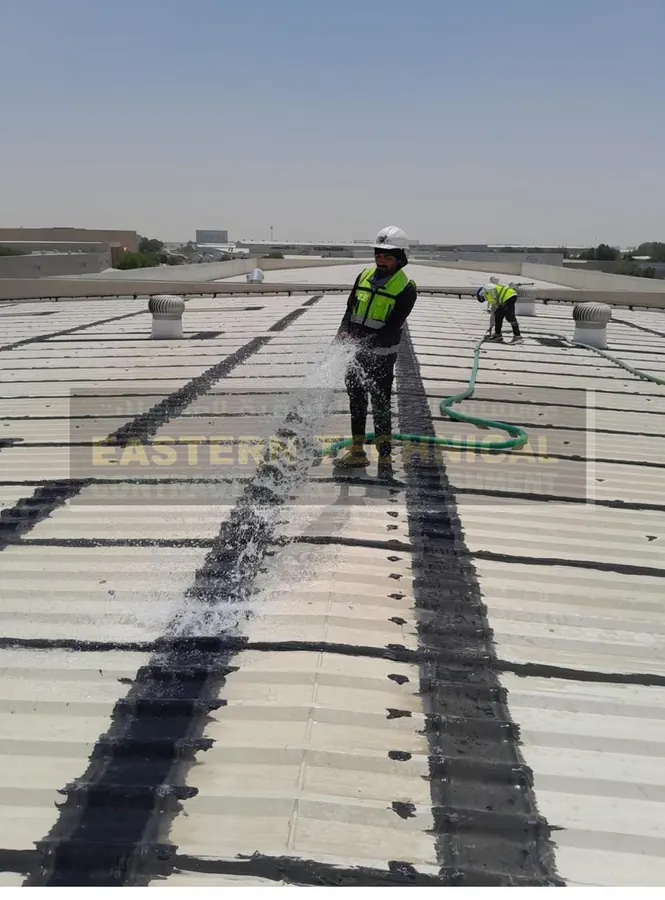
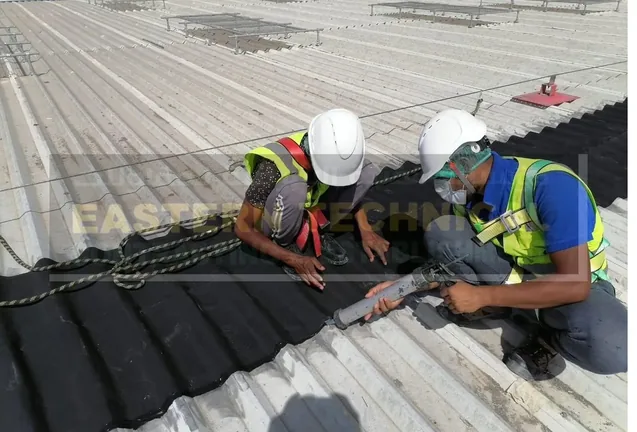
If the leak is limited to isolated fasteners, minor open joints, or a small penetration defect, targeted repair may be enough. That can include replacing failed screws, resealing laps, rebuilding flashing details, and treating early corrosion before applying a compatible waterproofing layer.
If the roof has recurring leaks across multiple zones, widespread rust, failed transitions, or repeated patch history, sectional rehabilitation is usually the smarter option. In these cases, the goal shifts from spot repair to restoring continuity across the weak areas. This is where engineered waterproofing systems, especially EPDM-based solutions for complex details, can provide longer service life than repeated sealant-only work.
What a proper inspection should look for
A serious roof inspection goes beyond visible stains and obvious holes. It should review panel condition, fastener integrity, lap condition, existing sealants, penetrations, curb details, drainage performance, and signs of structural moisture impact. Interior mapping matters too. Water marks, rust trails, insulation saturation, and condensation patterns all help define whether the source is external leakage, internal humidity, or a combination of both.
For active industrial facilities, inspection also needs to account for operations. Roof-mounted equipment, foot traffic routes, maintenance access, process exhaust, and washdown practices can all contribute to failure. A technically useful report should separate immediate leak points from developing defects so maintenance teams can prioritize correctly.
This is one reason many facility managers prefer a contractor that can inspect, diagnose, fabricate required components, execute repairs, and support follow-up without handing the site between multiple vendors. ETCE KSA operates in that model because industrial leak problems rarely stay inside one trade boundary.
Repair methods that hold up better over time
The best roof leak repair work is usually built around preparation, not just product selection. Corroded surfaces have to be cleaned and stabilized. Failed sealants must be removed where necessary instead of being buried under another layer. Loose fasteners need replacement, not cosmetic coating. Drainage paths have to be cleared, and deformed areas need correction before waterproofing is applied.
For metal roofs, repair may involve sheet joint treatment, fastener replacement, local metal fabrication, flashing reconstruction, gutter rehabilitation, and waterproofing at vulnerable junctions. EPDM-based systems are especially effective at penetrations, curb flashings, drain points, and irregular transitions because they tolerate movement better than many rigid patch methods.
That said, not every roof needs a full membrane-based overlay. If the substrate is badly deteriorated or structural corrosion is advanced, deeper rehabilitation may be required. This is where technical judgment matters. Over-repair adds cost, but under-repair creates repeat failure and disrupts operations later.
Why cheap patching usually fails
Industrial clients often inherit roofs that have already been patched several times. You can usually spot them immediately – mixed sealants, random sheet pieces, uneven coating strips, and incompatible materials applied over rust or dust. These repairs may slow leakage briefly, but they rarely address movement, substrate condition, or water path complexity.
The cost problem is not just the patch itself. Every repeat leak adds hidden loss through damaged inventory, production interruption, false ceiling replacement, electrical risk, labor coordination, and emergency mobilization. When viewed over a year or two, a low-cost temporary patch can become the most expensive option on the building.
How to prioritize repairs across a large facility
Large facilities do not always need full-site intervention at once. In many cases, the practical route is to rank zones by operational risk. Areas above finished goods, electrical rooms, control panels, offices, sensitive equipment, and active production lines should move first. Next come drainage failures, penetration clusters, and corrosion zones that can spread if left untreated.
A phased program works well when budgets are controlled but uptime still matters. The key is to phase based on engineering priority, not just visible drips. Some non-leaking defects are more urgent than current minor leakage because they indicate approaching system failure.
Preventing the next leak event
A repaired roof still needs maintenance discipline. Industrial roofs in hot, dusty environments should be checked routinely for blocked outlets, lifted laps, loose fasteners, sealant fatigue, impact damage, and early corrosion. This is especially true after storms, equipment installation, or any trade activity on the roof.
Preventive maintenance is not complicated, but it has to be consistent. Short inspection cycles, clear photo documentation, and quick correction of minor defects usually extend service life far more effectively than waiting for interior leakage to appear. For older warehouses and factories, annual or semiannual reviews can prevent a manageable defect from becoming a major rehabilitation project.
Choosing a contractor for roof leak repair Saudi Arabia
For industrial and commercial assets, contractor selection should come down to technical fit and execution strength. The right team should understand metal roof behavior, waterproofing compatibility, drainage design, penetration detailing, and the realities of working around live operations. Fast response matters, but diagnosis quality matters more.
Ask how the leak source will be confirmed, what repair system is being proposed, whether the solution matches the roof type, and what support is available after installation. If a contractor talks only about sealant and speed, that is usually a warning sign. If they can explain the failure mechanism, the repair detail, and the expected service outcome, you are dealing with a more reliable partner.
A leaking roof over a factory or warehouse is never just a maintenance nuisance. It is an early signal that the building envelope is losing control at one or more critical points. Handle it with the same seriousness you would give any production-critical asset, and the roof will stop being a recurring problem and start performing like part of the facility should.
Related ETCE services
Need this checked on your own roof?
ETCE carries out industrial roof inspections, leak diagnosis, metal roof rehabilitation and EPDM waterproofing across Dammam, Al Khobar, Dhahran, Jubail, Riyadh and Jeddah.
Request a Roof Inspection WhatsApp UsMetal roof waterproofing across Saudi Arabia
ETCE is a metal roof waterproofing company in Saudi Arabia with its head office in Dammam. See our warehouse & factory roof waterproofing service or find your area: