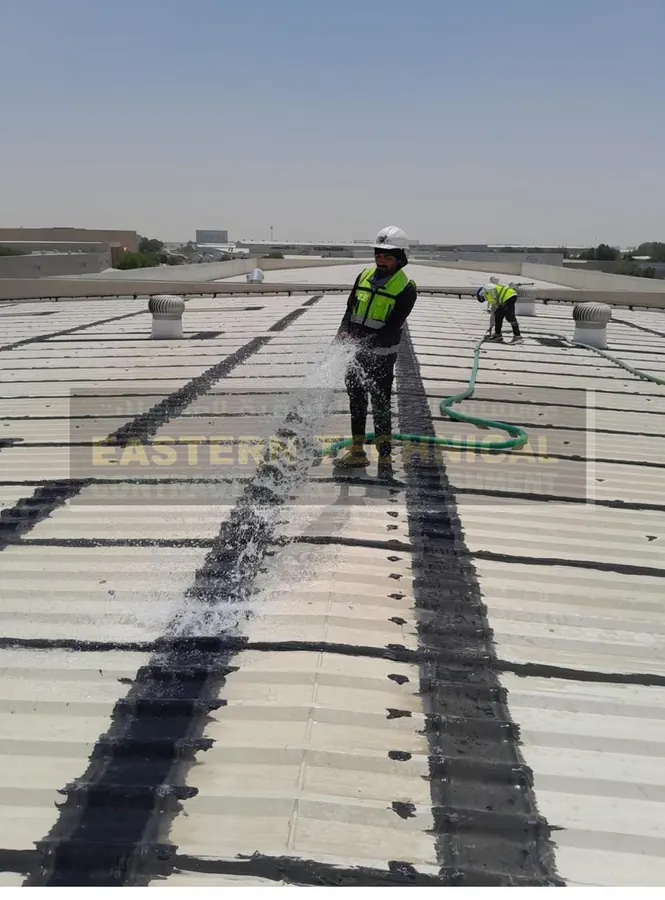
A factory roof rarely starts leaking all at once. More often, the first sign is a brown stain near a beam line, water around a machine bay after rain, or rust forming where panels meet. When facility teams ask about the top causes of factory roof leaks, the real issue is usually not one defect but a chain of failures – aging materials, movement, poor detailing, and delayed maintenance working together.
In industrial buildings, roof leaks are operational problems, not cosmetic ones. Water intrusion can interrupt production, damage stock, accelerate corrosion, compromise insulation, and create safety risks for people and equipment below. That is why leak diagnosis has to go beyond patching the visible wet spot. The source is often higher up, farther away, or hidden inside laps, penetrations, or gutter interfaces.
Why factory roofs fail differently
Factory and warehouse roofs operate under harder conditions than many commercial buildings. Large spans expand and contract under heat. Metal sheets vibrate under wind load. Rooftop equipment creates extra penetrations. Dust, sand, standing water, and neglected drainage all add stress to weak points.
A small office roof leak may be limited to one membrane tear. A factory roof leak can travel through panel laps, insulation layers, purlin lines, and internal channels before it becomes visible inside. That makes proper diagnosis essential. Treating the symptom without correcting the failure point usually leads to repeat leaks after the next storm.
Top causes of factory roof leaks in industrial buildings
Failed fasteners and enlarged fixing holes
On metal roofs, fasteners are one of the most common leak points. Over time, screws can back out due to thermal cycling, vibration, wind uplift, or improper original installation. Once a fastener loosens, the washer no longer seals the penetration properly, and water starts entering around the fixing point.
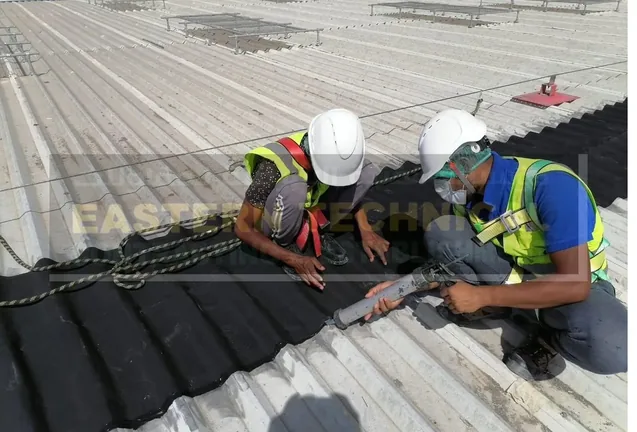
In older roofs, the issue is not just a loose screw. The hole itself may become enlarged or distorted, especially where corrosion has weakened the surrounding sheet. Re-tightening the same fastener rarely solves that condition for long. In many cases, the roof needs replacement fasteners, sealing treatment, or a more engineered waterproofing repair across affected zones rather than isolated spot work.
Open laps and failed side seams
Long-sheet and corrugated metal roofs depend on side laps, end laps, and joint integrity to remain watertight. When these laps separate, shift, or lose their sealant bond, wind-driven rain can move under the sheets and travel surprisingly far.
This failure becomes more common as roofs age or where the original detailing was weak. Buildings with high heat exposure see repeated expansion and contraction, which places stress on laps every day. If sealants have hardened, shrunk, or cracked, the joint is already vulnerable before the rainy season begins.
Roof penetrations that were never properly detailed
Every penetration is a risk point. Pipes, ducts, cable trays, vents, skylights, smoke vents, and support brackets interrupt the roof surface and create edges where water can enter. In industrial buildings, these areas often leak because later modifications were installed without proper flashing design.
This is one of the top causes of factory roof leaks because penetrations are frequently treated as secondary details when they should be treated as engineered interfaces. A good roof sheet can still leak badly if the penetration flashing is undersized, poorly sealed, mechanically stressed, or incompatible with the roof profile.
Blocked gutters and poor drainage
A roof system is only as effective as its drainage path. Internal gutters, valley gutters, downpipes, and drain outlets often become blocked with dust, debris, bird nesting material, or construction residue. Once drainage slows, water ponds in areas never meant to hold it.
Standing water increases hydrostatic pressure at laps, fasteners, and penetrations. It also accelerates corrosion in gutters and low points. On sandwich panel and metal sheet roofs, ponding can expose weaknesses that would not leak under normal runoff conditions. In practical terms, many chronic roof leaks are drainage problems first and waterproofing problems second.
Corrosion in sheets, gutters, and accessories
Rust is not just a surface issue. Once corrosion starts eating through metal roofing components, the roof loses thickness, strength, and continuity. Pinholes can form in sheet crowns or gutter troughs. Protective coatings can break down around cut edges, overlaps, and screw points. Over time, those vulnerable areas become active leak paths.
Corrosion tends to be worse in facilities with moisture, chemicals, salt exposure, process exhaust, or poor housekeeping around gutters and roof details. It also spreads faster where water is trapped. A badly rusted gutter joint, for example, can send water back into the building envelope long before total metal failure is obvious from below.
Damaged or aged skylight details
Skylights and translucent roof sheets are common leak zones in factories and warehouses. The issue may be cracked panels, failed perimeter sealant, brittle fixing points, or movement between dissimilar materials. Older skylight assemblies often become fragile under UV exposure and heat, which leads to hairline fractures and failed edge detailing.
Many leak complaints reported as general roof failure are actually concentrated around skylight curbs and joints. These areas need careful inspection because water can enter at the edge and travel along structural lines before dripping inside.
Movement and thermal expansion
Metal roofs move. That movement is normal, but it has to be accommodated in the design and the repair method. If the roof has long runs, insufficient allowance for thermal movement, or rigid patching over active joints, the system will eventually crack or separate.
This matters in hot climates where roof temperatures swing sharply across the day. A repair that looks sound at installation can fail early if it does not flex with the roof. That is why factory leak repair is not just about closing a hole. Material compatibility and movement tolerance matter just as much.
Poor previous repairs
One of the most expensive causes of repeat leakage is bad repair history. Site teams under pressure sometimes use generic mastics, short-term tapes, or surface patches that do not match the roof type or the source of water entry. Those repairs may slow the leak briefly, but they usually trap moisture, mask corrosion, or fail under heat and movement.
A factory roof with years of patchwork often becomes harder to diagnose because each old repair changes the water path. In those situations, a proper inspection should assess the roof as a system, not as a collection of isolated defects.
Why leak location can be misleading
Inside the building, water appears where gravity finally forces it out. That may be several meters away from the original entry point. Water can move along purlins, insulation facings, panel undersides, cable routes, and structural members before it drips.
That is why visual interior evidence should guide inspection, not control it. A technician needs to read the roof layout, slope direction, penetration density, gutter condition, and sheet joints above the affected zone. Without that discipline, crews end up sealing the wrong area and calling the leak fixed until the next rain proves otherwise.
What a proper response looks like
The right repair depends on what is actually failing. If the issue is isolated fasteners, targeted replacement and sealing may be enough. If there is widespread corrosion, failed laps, and gutter deterioration, the better option may be sectional rehabilitation with a durable waterproofing system designed for metal roofs and difficult details.
For many industrial buildings, the strongest results come from combining inspection, substrate preparation, detail treatment, and reinforced waterproofing at critical points such as penetrations, gutters, skylights, and drain zones. This is where specialized EPDM-based repair systems can perform well, especially on aging metal roofs with movement and recurring leak points. ETCE KSA often addresses these exact conditions in active industrial facilities where shutdown time, access constraints, and long-term durability all matter.
How facility teams can reduce future leaks
The most effective way to reduce leakage is to stop treating the roof as a reactive maintenance item. Scheduled inspections before and after rainy periods, fastener checks, gutter cleaning, corrosion review, and penetration audits catch small failures before they spread.
It also helps to track every modification made on the roof. New duct supports, cable penetrations, exhaust points, and temporary contractor work are common sources of future leaks if they are not detailed correctly. In industrial environments, roof integrity can change quickly after one poorly managed intervention.
A factory roof does not need attention because it is old. It needs attention because water will always find the weakest detail first. The smart move is to identify that detail before the next leak does it for you.
Related ETCE services
Need this checked on your own roof?
ETCE carries out industrial roof inspections, leak diagnosis, metal roof rehabilitation and EPDM waterproofing across Dammam, Al Khobar, Dhahran, Jubail, Riyadh and Jeddah.
Request a Roof Inspection WhatsApp UsMetal roof waterproofing across Saudi Arabia
ETCE is a metal roof waterproofing company in Saudi Arabia with its head office in Dammam. See our warehouse & factory roof waterproofing service or find your area: