A warehouse leak rarely stays a roof problem for long. Once water starts entering through laps, penetrations, gutters, skylights, or fastener lines, it moves into insulation, steel members, electrical zones, stored goods, and daily operations. That is why warehouse roof leak repair has to be treated as a building performance issue, not a patching exercise.
In industrial facilities, leaks are often reported at the point where water appears, not where it actually enters. A drip over a production line may be coming from a failed roof lap several meters away. Water can travel along purlins, insulation facings, cable trays, and deck profiles before showing itself inside the building. If the repair approach starts and ends with surface sealant at the visible drip point, the same complaint usually returns after the next rain.
Why warehouse roof leak repair fails so often
Most repeat failures come down to poor diagnosis. Industrial roofs are exposed to heat, UV, dust, movement, standing water, aging fixings, and years of service modifications. By the time a facility team notices active leakage, the roof may already have multiple weak points rather than one isolated defect.
Metal warehouses are especially vulnerable at end laps, side laps, screw penetrations, ridge zones, gutter interfaces, and roof-mounted equipment supports. Expansion and contraction gradually stress sealant lines and loosen fixings. Once washers crack or metal starts corroding around fasteners, water finds a path quickly. On older roofs, earlier repairs can create another problem if incompatible materials were applied over rusted, dirty, or unstable surfaces.
There is also the issue of access and urgency. Many facilities need a leak stopped immediately because stock, machinery, or production cannot wait. Emergency action is necessary, but temporary control and permanent repair are not the same thing. A fast-response crew should stabilize the problem first, then return with a repair scope that addresses the actual failure points and surrounding roof condition.
The right way to approach warehouse roof leak repair
A durable repair starts with inspection, not assumptions. The roof surface, drainage pattern, flashing details, fastener condition, penetrations, skylights, smoke vents, gutters, and internal leak locations all need to be reviewed together. The goal is to trace the water path, identify the entry point, and understand whether the leak is local, systemic, or tied to roof aging.
In practice, this usually means looking beyond the obvious tear or opening. A small split near a penetration may be the visible defect, but the underlying cause could be ponding water, failed detailing, structural movement, or corrosion around the support. If that cause is left in place, the repair life drops sharply.
For facility managers and project teams, the most useful inspection outcome is a clear condition report. Not just photos of damage, but a practical distinction between urgent repairs, medium-term rehabilitation needs, and areas that should be monitored. That helps maintenance budgets align with risk instead of chasing one leak call after another.
Common failure points on industrial warehouse roofs
Warehouse roofs tend to leak at predictable locations. Penetrations are one of the biggest sources of trouble because every pipe, vent, curb, cable route, or equipment stand interrupts the roof plane. If these points were poorly detailed at installation or altered later by other trades, water entry becomes likely.
Gutters are another major issue. When gutters hold standing water, overflow during rain, or corrode at joints, the leak problem can spread to fascia lines, wall interfaces, and internal edges. In large warehouses, one failed gutter section can create repeated complaints in multiple bays.
Skylights and smoke vents also need close attention. The leak is not always through the unit itself. It may be through failed perimeter flashing, cracked sealant, loose fixings, or movement between the roof sheet and the upstand. The same applies to roof transitions where different materials or slopes meet.
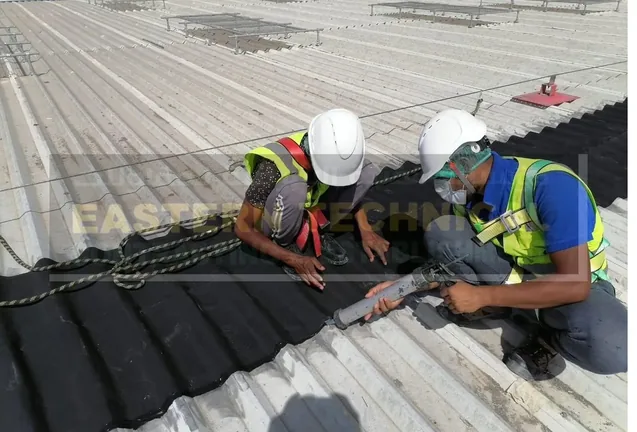
On metal roofs, fastener lines deserve careful inspection. Worn washers, uplift movement, panel vibration, and corrosion around fixing points are common in aging industrial stock. A roof with widespread fastener deterioration should not be treated as a one-spot repair situation.
Repair methods depend on roof condition
Not every warehouse needs full roof replacement, and not every leak can be solved with sealant. The right repair method depends on substrate condition, extent of corrosion, roof geometry, access constraints, and how much service life the client needs from the building.
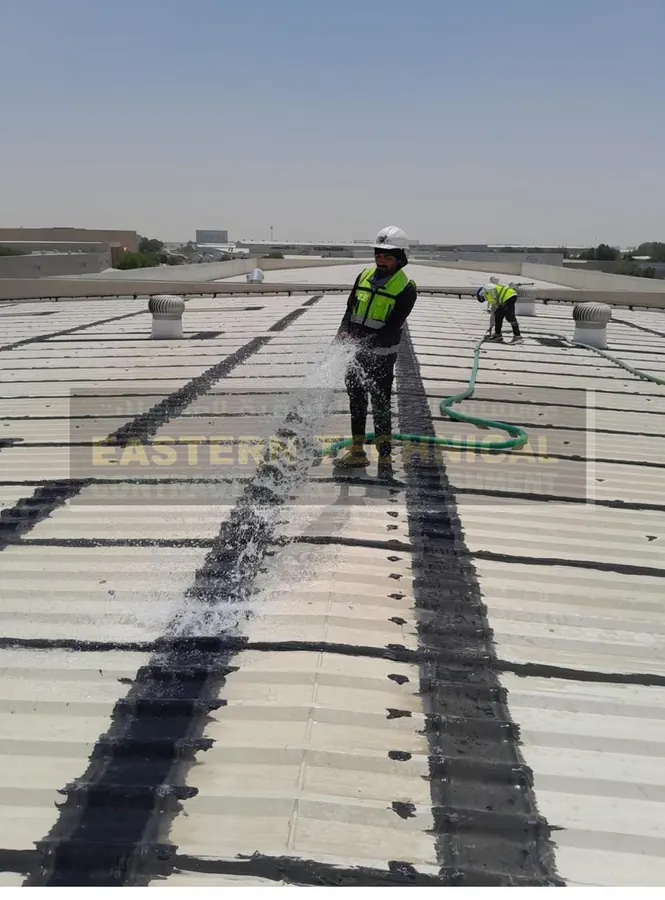
For isolated defects, local repair can be effective if the surrounding roof remains sound. This may involve replacing damaged fixings, resealing laps, treating corrosion, rebuilding flashing details, or repairing localized membrane or sheet failures. The key is proper surface preparation and material compatibility.
For recurring leaks around complex details, EPDM-based waterproofing can be a strong option. Difficult points such as gutters, penetrations, drain points, skylights, and smoke vents often need a system that can handle movement, irregular geometry, and long-term weather exposure better than basic surface patching. When installed correctly on prepared substrates, these systems provide a more reliable seal across vulnerable transitions.
If the roof has multiple active leak points, widespread rust, failed detailing, and repeated patch history, rehabilitation is usually more economical than chasing isolated repairs. In that case, the scope may include metal treatment, replacement of degraded components, waterproofing of critical junctions, gutter rebuilding, and coordinated repairs across the roof envelope. This is where an engineering-led contractor has an advantage because diagnosis, fabrication, waterproofing, and maintenance can be managed as one solution rather than split across several vendors.
Speed matters, but detail matters more
Industrial clients often ask one fair question: how fast can the leak be stopped? The answer should balance emergency response with repair quality. Immediate containment protects operations. Permanent work protects the asset.
A rushed repair over wet, dirty, unstable, or corroded surfaces may hold briefly, then fail under heat and movement. In Gulf conditions, roofs face intense UV, high surface temperatures, dust contamination, and thermal cycling. Those conditions punish weak preparation and shortcut detailing. Good warehouse roof leak repair is not just about applying a product. It is about preparing the substrate properly, rebuilding vulnerable details, and using materials suited to the roof type and exposure.
That is also why documentation matters. When the repair team records defect locations, likely causes, completed works, and any remaining risk areas, the facility team gains a workable maintenance roadmap. This is more useful than a one-line statement that the leak was fixed.
When a leak points to a bigger asset problem
A roof leak sometimes reveals issues outside the roof itself. Internal condensation can be mistaken for roof leakage, especially in buildings with temperature differentials, poor ventilation, or damaged insulation. Structural movement may crack flashing lines repeatedly. Overflowing roof drainage may indicate slope problems or blocked outlets rather than membrane failure.
This is where experienced site assessment makes a difference. The repair scope should reflect actual building behavior, not just surface symptoms. On industrial sites, there is rarely value in treating each trade as separate when the failure crosses waterproofing, metalwork, drainage, access, and maintenance.
For example, a leaking gutter edge may require waterproofing, localized fabrication, support adjustment, protective coating, and related repair to adjacent roof sheet interfaces. Splitting that into multiple contractors often slows the response and leaves gaps in responsibility. A single contractor with waterproofing, metal rehabilitation, and maintenance capability can usually control the outcome better.
What decision-makers should expect from a repair contractor
For commercial and industrial assets, leak repair should start with a proper site inspection and a direct explanation of what is failing, why it is failing, and what level of intervention is justified. Clients should expect more than a temporary patch proposal. They should expect a method statement aligned to roof condition, operating constraints, safety access, and long-term performance.
They should also expect realism. Some roofs support local repair well. Others are too deteriorated for isolated patching to be cost-effective. A dependable contractor will say so clearly and support that recommendation with findings from the roof. ETCE KSA approaches these projects from that practical angle – inspection first, then engineered repair based on actual site conditions.
Warehouse roofs do not need perfect language. They need decisive technical action, clean execution, and repairs that respect how industrial buildings age in harsh climates. If water is entering your facility, the right next step is not to keep patching the symptom. It is to identify the true failure point, repair the surrounding detail properly, and give the building a roof system that can keep doing its job after the next storm passes.
Related ETCE services
Need this checked on your own roof?
ETCE carries out industrial roof inspections, leak diagnosis, metal roof rehabilitation and EPDM waterproofing across Dammam, Al Khobar, Dhahran, Jubail, Riyadh and Jeddah.
Request a Roof Inspection WhatsApp UsMetal roof waterproofing across Saudi Arabia
ETCE is a metal roof waterproofing company in Saudi Arabia with its head office in Dammam. See our warehouse & factory roof waterproofing service or find your area: