A warehouse roof usually does not fail all at once. It starts at the lap joint that opens under thermal movement, the gutter that holds standing water after dust buildup, the skylight curb that was sealed once and forgotten, or the fastener line where rust begins to spread. A practical warehouse roof maintenance guide should focus on those early warning points, because that is where maintenance saves money, protects inventory, and avoids operational disruption.
For warehouse operators and facility teams, roof maintenance is not a cosmetic task. It is asset protection. Once water enters the building envelope, the problem moves fast – corrosion accelerates, insulation loses performance, interior safety risks increase, and production or storage areas become exposed. In hot, dusty, high-UV environments, metal roofs and panel systems also age under constant expansion and contraction, which means defects that look minor during a visual walkover can become active leaks during the next storm.
What a warehouse roof maintenance guide should actually cover
A useful warehouse roof maintenance guide is not a checklist copied from a manual. It should reflect roof type, building use, traffic levels, age, and known failure history. A logistics warehouse with multiple penetrations and smoke vents has a different risk profile than a simple storage shed with long-span metal sheets. A roof over sensitive stock also needs a lower tolerance for even minor water ingress.
The core objective is straightforward: keep water out, slow deterioration, and extend service life without waiting for emergency failure. That requires more than patching visible leaks. It means understanding how the full roof system behaves, including metal sheets, sandwich panels, gutters, downpipes, ridge details, penetrations, flashings, sealants, fasteners, supports, and movement joints.
Start with the highest-risk failure points
Most warehouse leaks are repetitive. They return to the same categories of defects, even when the exact location changes. On industrial roofs, common trouble areas include end laps, side laps, roof penetrations, gutter joints, skylight perimeters, drain points, and corroded fastener zones. If the building has older repairs from different contractors over many years, compatibility between materials can also become an issue.
Metal roofs in particular demand close attention because they move. Heat causes expansion, nighttime cooling causes contraction, and that cycling puts stress on sealants, screws, laps, and flashings. A repair that looks acceptable on day one may fail early if it does not account for movement. This is one reason temporary mastics alone often disappoint on large industrial roofs. They may slow water briefly, but they rarely solve the root condition if sheet corrosion, loose fixings, failed detailing, or drainage defects remain untreated.
Penetrations and roof-mounted services
Penetrations are one of the most common weak points on an otherwise serviceable roof. Pipes, ducts, cable trays, equipment supports, vents, and access modifications all interrupt the original weathering line. Over time, these details crack, lift, or separate. In many facilities, later mechanical or electrical works create penetrations without enough attention to waterproofing integrity.
A good maintenance program reviews every penetration detail, not just the ones currently leaking. If one curb has failed, others of similar age and construction may be close behind. This is where engineered waterproofing systems are more dependable than repeated local sealant applications.
Gutters, valleys, and drainage paths
Drainage defects are often underestimated because the water is visible only during rainfall. Dust, debris, loose fasteners, and deteriorated joint sealants can turn a functioning gutter into a failure point. Standing water increases corrosion risk, overloads weak sections, and raises the chance of backflow into laps and wall junctions.
Maintenance should verify that gutters drain freely, joints remain watertight, supports are stable, and discharge points are not restricted. If a warehouse has chronic overflow, the answer may not be cleaning alone. It may require re-detailing joints, correcting falls, replacing damaged sections, or reinforcing the waterproofing system around vulnerable drainage points.
Inspection frequency depends on site conditions
There is no single inspection interval that fits every warehouse. For most facilities, scheduled inspections twice a year are a sensible baseline, with additional checks after heavy rain, wind events, or rooftop works by other trades. Older roofs, buildings with known leak history, and facilities holding moisture-sensitive stock should be inspected more frequently.
What matters most is consistency and documentation. Inspections should track repeat defects, photograph changes, and identify whether a condition is stable, worsening, or already active. Without that record, maintenance becomes reactive. Teams fix the latest leak while missing the broader pattern.
This is where a detailed site report has real value. It helps owners distinguish between issues that need immediate repair, areas that need monitoring, and roof sections that may justify rehabilitation rather than continual patching. ETCE KSA works in that practical space – diagnose first, then match the repair method to the actual failure mechanism.
Maintenance is not the same as emergency leak response
Many warehouses spend too much on urgent callouts because no structured maintenance plan exists. Emergency repairs are necessary when stock, equipment, or operations are at risk, but they are not a maintenance strategy. They usually address the symptom under time pressure.
A proper program separates urgent containment from long-term correction. If a leak appears around a skylight, the immediate goal may be to stop water ingress. The permanent solution could involve replacing failed sealants, rebuilding flashing transitions, repairing corrosion, and installing a more reliable waterproofing detail around the curb. The difference matters because repeated short-term fixes often cost more over a year than one properly engineered repair.
Choosing the right repair approach
Not every roof needs replacement. In fact, many warehouse roofs have substantial remaining life if the defects are identified early and repaired correctly. The right approach depends on sheet condition, structural soundness, corrosion level, waterproofing detail quality, and the extent of prior failed repairs.
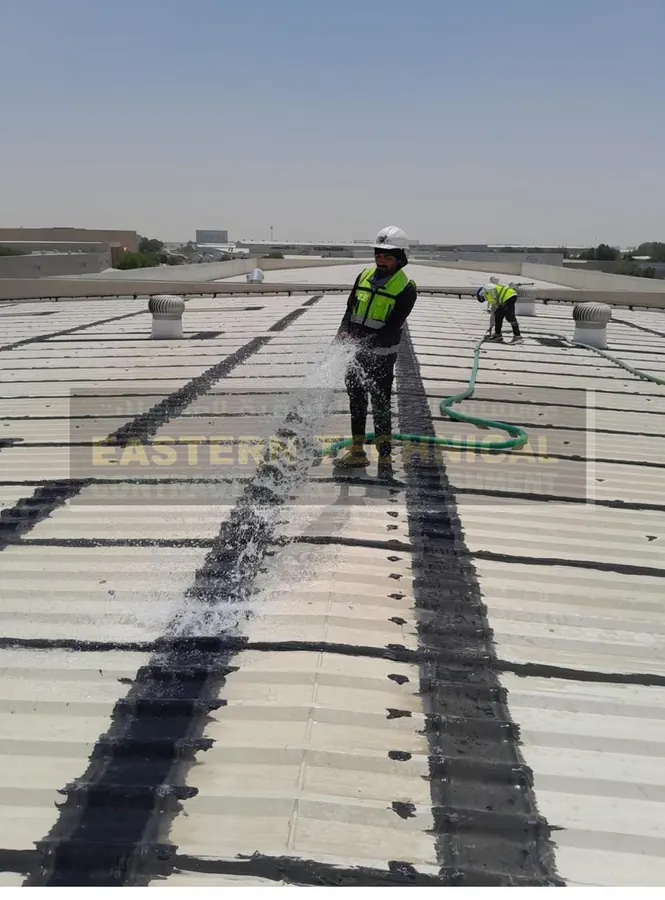
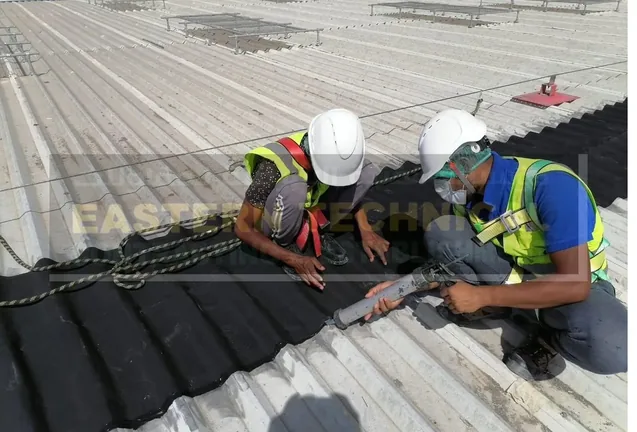
For localized defects, targeted repairs may be enough. That can include replacing damaged fasteners, sealing active laps with compatible systems, treating corrosion, refurbishing gutters, and rebuilding penetration details. But when leak points are widespread, the smarter option is often rehabilitation of the roof system rather than chasing individual failures one by one.
EPDM-based waterproofing is especially useful where movement, difficult detailing, and repeated leak points make conventional patching unreliable. It performs well around penetrations, skylights, smoke vents, gutter junctions, and drain areas where shape and movement create stress on simpler repair methods. That does not mean EPDM is the answer everywhere. If substrate preparation is poor or damaged metal is left untreated underneath, even a good membrane system can be compromised. Surface condition and detailing discipline still decide the outcome.
Why documentation and access control matter
One common reason warehouse roofs deteriorate faster than expected is uncontrolled rooftop traffic. Service teams for HVAC, electrical, communications, and other systems often walk the roof without a route plan or protection measures. Panels get dented, sealants are disturbed, and small punctures go unnoticed.
Maintenance should include access rules, designated walk paths where needed, and a requirement that any new penetration or rooftop modification is reviewed for waterproofing impact. A roof can be in acceptable condition and still develop leaks simply because later works ignored the original system.
Documentation is equally important. When inspection findings, repair dates, product types, and recurring defect zones are recorded clearly, facility managers can make better budgeting decisions. They can also spot when a section has become a repeat expense and should move from maintenance into capital repair planning.
Build a plan around the building, not a generic schedule
The strongest maintenance plans are site-specific. They consider roof age, exposure, occupancy sensitivity, shutdown costs, safety access, and whether repairs must be staged around live operations. A warehouse handling high-value inventory may justify earlier intervention than a low-risk storage building, even if both roofs show similar wear.
That is why a warehouse roof maintenance guide should be practical, not theoretical. Know where the roof fails first. Inspect before the rainy season, not after it. Treat drainage as a system, not a housekeeping issue. And when leak points start repeating, stop paying for the same problem twice.
A warehouse roof does not need attention because it is old. It needs attention because failure at roof level spreads through the whole facility faster than most teams expect. The right maintenance approach keeps that failure contained long before it reaches operations, stock, and structure.
Related ETCE services
Need this checked on your own roof?
ETCE carries out industrial roof inspections, leak diagnosis, metal roof rehabilitation and EPDM waterproofing across Dammam, Al Khobar, Dhahran, Jubail, Riyadh and Jeddah.
Request a Roof Inspection WhatsApp UsMetal roof waterproofing across Saudi Arabia
ETCE is a metal roof waterproofing company in Saudi Arabia with its head office in Dammam. See our warehouse & factory roof waterproofing service or find your area: